

When India established full diplomatic relations with Israel in 1992, it opened a door that would gradually widen over the next three decades. Under Narendra Modi, that door was flung open.
For years, India’s approach to Israel and Palestine was “hyphenated”—engagement with one carefully balanced by outreach to the other. This reflected India’s historical support for Palestinian statehood and its domestic political sensitivities. But Modi’s government articulated a new principle: de-hyphenation. India would pursue relations with Israel on their own merits, independent of its ties with Palestine.
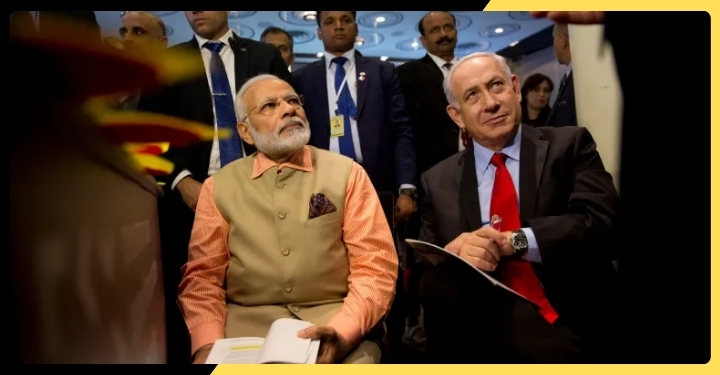
The 2017 Israel visit was emblematic. Modi did not travel onward to Ramallah, breaking precedent. His visible rapport with Benjamin Netanyahu underscored shared interests in defense innovation, agriculture technology, and counterterrorism. Israel, already a major arms supplier to India, became an even more significant strategic partner.
This shift coincided with India’s broader geopolitical repositioning. As India sought advanced defense systems and technological partnerships, Israel proved a willing and capable collaborator. Joint ventures expanded, and bilateral trade diversified beyond military hardware into water management, startups, and space cooperation.
Critics argue that this strategic tilt diluted India’s moral voice on Palestine. While New Delhi continues to endorse a two-state solution in principle, its rhetoric has softened and its diplomatic signaling changed. Abstentions in certain UN votes and toned-down statements during flare-ups in Gaza were viewed by some observers as indicative of recalibration.
Yet proponents maintain that India’s interests demanded realism over rhetoric. The Middle East itself was changing, with Arab states normalizing relations with Israel. India’s strengthening of ties with Israel did not preclude deepening relations with Gulf countries; rather, it reflected a multipolar approach.
In this reading, Modi did not abandon Palestine but reframed India’s foreign policy around strategic autonomy. The result was a visible, unapologetic partnership with Israel—one that would have been politically unthinkable in earlier decades.
