
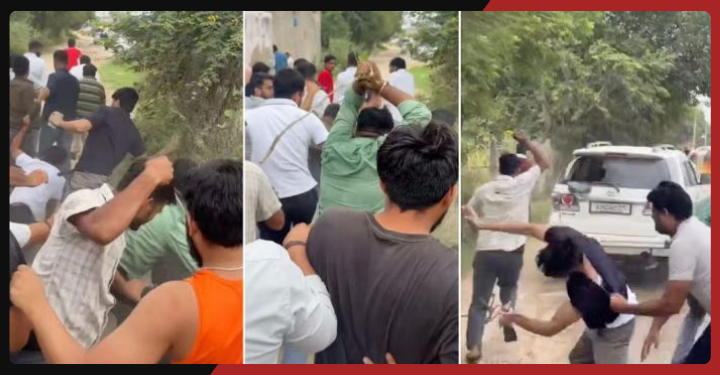

The Cockroach Janta Party has escalated its confrontation with the Rajasthan government after alleging that its volunteers were attacked during a school-inspection visit in Jaipur district. Following the incident, CJP demanded arrests within 48 hours and warned that it could launch a statewide agitation if action was not taken.
CJP founder Abhijeet Dipke said co-convenor Ashutosh Ranka and other volunteers were allegedly beaten during the inspection. The organisation also alleged that vehicles were vandalised and stones were thrown at members of the team. Dipke accused individuals allegedly associated with the BJP of involvement and questioned the response of the Rajasthan Police.
Ranka said the team had travelled to Rampura-Kanwarpura village as part of the “School Thik Karo” campaign. The organisation’s objective was to examine the condition of a government school and document infrastructure problems. Ranka reportedly claimed that the school had been operating from a buffalo shed for years, making it an example of what the campaign describes as neglect of public education.
The situation reportedly deteriorated when local residents opposed the CJP team’s visit. Videos shared from the location show confrontation between the two sides, while reports describe the CJP members being chased away. Damage to vehicles was also reported.
CJP has portrayed the episode as part of a larger pattern of resistance against its school campaign. The organisation has argued that its volunteers are simply documenting public facilities and bringing complaints to the attention of authorities. It has previously announced plans to inspect schools in Jaipur, Ajmer, Jodhpur, Udaipur, Dholpur, Bharatpur, Kota, Barmer and Hanumangarh.
However, the political accusations remain disputed. Local residents have reportedly denied the CJP’s allegations about the nature of the confrontation. They said they objected to the political organisation’s presence and questioned the need for an external inspection. Some villagers also pointed to government funding already approved for the school.
The dispute is occurring against the backdrop of a new Rajasthan Education Department order regulating access to government schools. The department has instructed schools to prevent unauthorised entry and has restricted photography, videography, interviews and live streaming without permission.
Officials have justified the rules on the basis of student safety, privacy and dignity. The order refers to constitutional privacy rights and child-protection guidelines. School authorities have been instructed to prevent unauthorised collection or circulation of information about students.
CJP, however, has questioned the timing of the restrictions. The organisation announced its inspection campaign shortly before the order was issued, creating speculation about whether the rules were partly prompted by the campaign. The government has defended the restrictions as safeguards rather than political measures.
The latest violence allegation has now raised the stakes considerably. CJP’s 48-hour demand puts pressure on the administration to respond quickly. If arrests or an investigation follow, the controversy could move into a formal legal process. If the organisation believes no action has been taken, its threatened statewide agitation could create further tension.
Education Minister Madan Dilawar has become a central figure in the dispute because CJP has repeatedly criticised the state government’s handling of school infrastructure. The organisation has challenged the minister to demonstrate the best schools developed under his tenure and has demanded accountability for schools it says remain in poor condition.
The controversy now has two separate but connected dimensions. One concerns alleged violence and the responsibility of police and administration. The other concerns the condition of government schools and whether citizens should be able to independently scrutinise them.
Both questions require evidence.
An impartial inquiry into the alleged assault could establish what happened during the visit. At the same time, an official audit of the school could determine whether the infrastructure allegations are accurate and whether sanctioned funds have been properly used.
For parents and students, these outcomes are more important than political claims. Government schools must provide safe and functional learning environments regardless of which organisation raises the issue.
The CJP’s ultimatum has therefore placed Rajasthan authorities under renewed scrutiny. The coming days will reveal whether the dispute leads to arrests and investigation, further political confrontation, or a more structured system for independent school monitoring.
