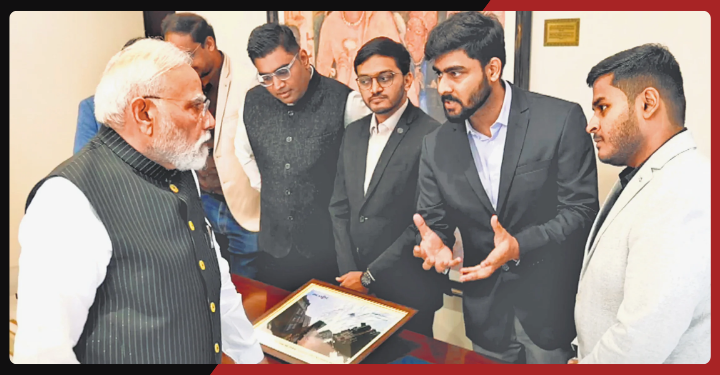

Prime Minister Narendra Modi has urged India’s private space sector to make the country a global destination for space professionals, companies and investment. During a recent interaction with founders and CEOs of 20 space startups, he said India has the potential to establish itself rapidly in the international space industry.
Modi highlighted India’s cost competitiveness, skilled workforce and entrepreneurial risk-taking as important advantages. He said the country should create an environment that encourages people from around the world to look towards India when deciding where to build their future in the space sector.
The Prime Minister’s emphasis on talent comes as the global space industry becomes increasingly competitive. Countries and companies are investing in launch systems, satellites, Earth observation, communications, navigation, artificial intelligence and other emerging technologies.
For India, attracting international talent could help accelerate the development of advanced capabilities. Professionals with experience in international space programmes can contribute technical expertise, management knowledge and global connections.
But Modi’s vision is broader than simply recruiting skilled professionals. He wants India to become an ecosystem where talent, capital and businesses naturally come together.
The private sector is expected to play a central role in building that ecosystem. India’s space reforms have encouraged companies to enter areas that were previously largely associated with government institutions.
The results are becoming visible. Government figures released in July showed private investment in the Indian space sector had crossed $618 million and 105 authorisations had been issued to private entities.
The number of startups has also grown substantially. The government reported that India’s private space ecosystem had crossed 400 startups by June 2026.
These companies are working on technologies ranging from rockets and satellites to propulsion, space intelligence, debris removal and AI-based weather systems.
Such diversity could help India develop a complete space economy rather than relying on a small number of launch providers.
Modi has also stressed that the private space industry should solve problems on Earth. He encouraged companies to explore applications in agriculture, livestock, dairy and environmental monitoring.
This could open new markets for startups while improving public services. Satellite imagery and data can support crop monitoring, weather forecasting, environmental assessment and disaster management.
The Prime Minister also underlined the importance of stable policies. Space technology is a long-term business, and companies often need years to develop and test their products. Entrepreneurs therefore need confidence that the regulatory environment will remain predictable.
According to Modi, consistent policy can create trust between the government and private companies, allowing entrepreneurs to take risks without fearing sudden changes in the rules.
Education is another part of the government’s strategy. Modi suggested greater collaboration with Atal Tinkering Labs to encourage students to develop an early interest in space and technology.
Building a large talent pipeline will be essential if India wants to compete globally. A rapidly growing industry cannot depend only on existing professionals; it needs continuous investment in education and research.
The challenge for India will be converting its advantages into global leadership. Competitive costs may attract customers, while skilled workers can create advanced products. But international success will also require reliability, quality, strong intellectual property and access to global capital.
Modi’s comments suggest that India wants to compete on all these fronts.
The objective is not merely to launch more rockets. It is to make India a place where the world’s space industry sees opportunities to innovate, invest, work and build businesses.