
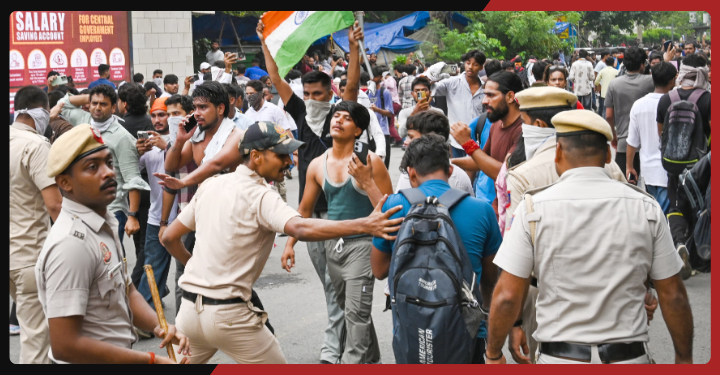

The recent protests at Delhi’s Jantar Mantar have prompted Delhi Police to rethink how its personnel interact with young demonstrators. Following widespread circulation of videos showing police-protester interactions, the force has reportedly issued guidelines aimed at improving the conduct of officers during future demonstrations.
The new instructions reportedly emphasise calmness, silence and professional behaviour. Personnel have been told to avoid unnecessary engagement with protesters and not to respond emotionally to provocative questions or appeals.
The guidelines come at a time when youth-led protests are increasingly shaped by social media. Young demonstrators often carry smartphones during rallies, meaning that police actions can be recorded from close range and distributed instantly.
This was particularly visible during the Jantar Mantar demonstrations. Protesters filmed officers and some of those interactions became widely circulated online.
The police advisory reportedly warns personnel that an angry expression or emotional response can become content for protesters. Officers have therefore been encouraged to remember that they are effectively performing their duties in front of a camera even when no traditional media organisation is present.
The advice reportedly includes a recommendation to avoid arguments. When necessary, officers can simply tell protesters to cooperate because police personnel are carrying out their duties. Otherwise, silence is preferred.
The instructions reportedly go further by warning officers about emotional situations. Protesters may cry, make personal appeals or raise questions involving family background and salary. Personnel have been told not to respond by debating or expressing agreement.
The purpose is to prevent emotional exchanges from escalating.
The guidelines also reportedly advise personnel to exercise particular care when dealing with women protesters. Where possible, unnecessary physical contact should be avoided, while women police personnel should handle interactions with women demonstrators.
The changes reflect a wider transformation in protest culture. Young people increasingly combine street demonstrations with digital campaigns. Reels, memes, livestreams and short videos can spread protest messages beyond the physical gathering.
Recent analysis of India’s youth-led protest movement has highlighted the role of digital media in helping young demonstrators organise and communicate their message.
For police forces, this creates both opportunities and challenges. Social media can provide evidence of incidents, but it can also amplify individual moments without the full background.
A confrontation lasting a few seconds may receive more attention than hours of peaceful protest.
The Delhi Police guidelines appear to be designed to reduce that risk by encouraging personnel to control their own behaviour.
This does not mean that police are being asked to abandon crowd-control responsibilities. Maintaining security around sensitive areas and preventing violence remain central duties. Rather, the reported instructions seek to make interactions more measured.
The development also demonstrates how police training must evolve alongside technology. Traditional methods of handling crowds cannot be separated from the communication environment in which those actions now take place.
For Gen Z protesters, filming is often part of participation. For police officers, being filmed is therefore unavoidable.
The most effective response, according to the reported guidelines, is not to fight the camera but to give it as little unnecessary drama as possible.
The Jantar Mantar episode may consequently mark a new phase in protest policing in Delhi — one where officers are trained not only to manage crowds but also to manage their own digital visibility.
In the age of viral videos, composure has become an important part of public-facing policing.
