
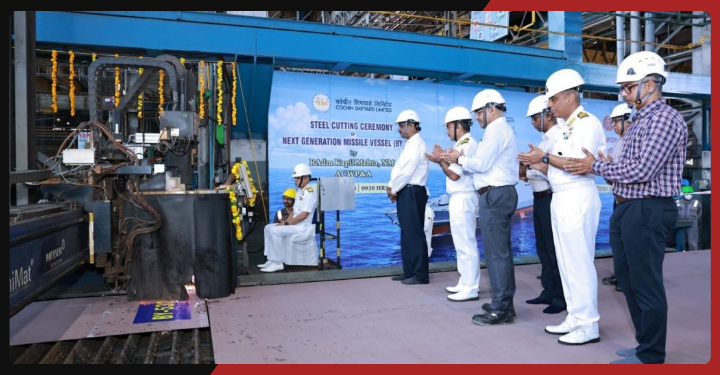

India’s effort to expand domestic defence manufacturing has received another boost with the keel laying of the first Next Generation Missile Vessel for the Indian Navy at Cochin Shipyard Limited in Kochi.
The ceremony, held on September 18, 2026, marked a major milestone in a six-vessel programme being executed by CSL. The Ministry of Defence has emphasised that major role-defining equipment for the NGMVs is being developed and manufactured indigenously.
The programme is connected to India’s broader Aatmanirbhar Bharat and Make in India objectives, which seek to increase domestic capacity in defence production. For naval shipbuilding, this involves not only constructing the hull of a vessel but also integrating complex weapons, sensors, communication systems and other equipment.
The NGMVs are planned to carry state-of-the-art weapons and sensors. Official information identifies surface-to-surface missile systems, anti-missile defence systems, air-surveillance radars and fire-control radars among the planned equipment.
The vessels are expected to be high-speed platforms. Their combination of speed, weapons and sensors is intended to provide the Navy with additional options for maritime operations.
The first NGMV began its construction journey with steel cutting in December 2024. CSL’s official release stated that the first steel plate for Ship No. BY-531 was cut during the ceremony on December 16 that year.
The keel laying on September 18, 2026, represents the next major construction milestone. Vice Admiral Sanjay Sadhu, Controller of Warship Production and Acquisition, attended the event as chief guest, alongside senior officials from the Navy and CSL.
The programme is also progressing on the second vessel. Steel cutting for the second NGMV took place at CSL on September 17, 2026, with Rear Admiral Kapil Mehta as chief guest.
The simultaneous progress of multiple ships is relevant to the programme’s overall schedule. The Navy has contracted CSL for six vessels, meaning the shipyard has to manage a continuing production line rather than deliver a single experimental platform.
The project has an order value of approximately ₹9,804 crore. CSL disclosed the value when announcing the steel-cutting milestone in December 2024.
From an industrial perspective, the programme is significant because it involves a class of advanced weapon-intensive platforms. The New Indian Express reported that the contract represents CSL’s entry into the construction of such advanced platforms for the Indian Navy.
Indigenisation can have several implications for defence manufacturing. Domestic development and production can create industrial expertise, strengthen supplier networks and increase the ability of Indian companies to participate in complex defence projects. At the same time, the successful integration and testing of these systems remain essential before a ship can become operational.
The NGMV programme is also part of a wider modernisation effort within the Indian Navy. Naval forces require different types of platforms for different missions, ranging from aircraft carriers and destroyers to frigates, corvettes, patrol vessels and missile platforms.
The NGMVs are intended to occupy a particular role within that broader fleet structure. Their planned capabilities include maritime strike, anti-surface warfare and local naval defence. They are also expected to contribute to the protection of offshore development areas.
The project therefore combines a military objective with an industrial objective. The Navy is seeking modern combat vessels, while India’s shipbuilding sector is gaining experience in constructing and integrating advanced platforms.
The September 2026 keel laying demonstrates that the programme has progressed beyond initial design and material preparation. The first vessel is now advancing through physical construction, while the second has entered its own construction process.
Further milestones will include continued fabrication, equipment installation, system integration, launch and sea trials. Only after these stages are completed can the vessels progress towards operational induction.
The NGMV programme consequently represents a continuing effort to build naval capability within India and to increase the domestic contribution to sophisticated defence platforms.
