
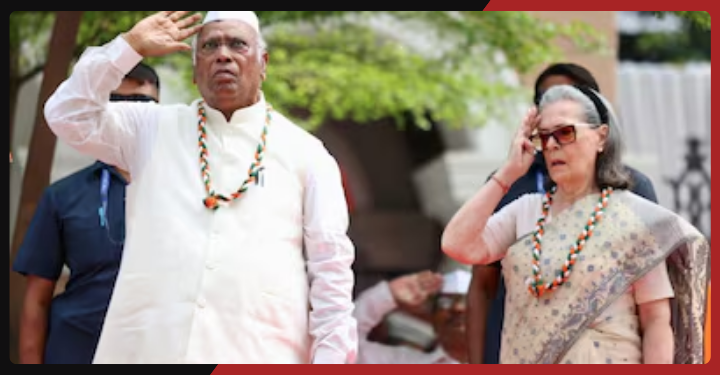

The Congress party has come under criticism after a viral video from its Independence Day celebration appeared to show Sonia Gandhi gesturing during the rendition of “Vande Mataram.” BJP leaders interpreted the footage as evidence that Congress leaders wanted to interrupt the song. Congress has rejected the allegation and defended Sonia Gandhi, saying her gesture was related to arranging a chair for party president Mallikarjun Kharge.
The controversy broke out on August 15, 2026, as India celebrated its 80th Independence Day. This year’s celebration has special significance because it also marks 150 years of “Vande Mataram.” The song has been given a prominent position in national ceremonies, including its historic performance from the Red Fort.
The Congress headquarters in Delhi hosted its own Independence Day event. Senior Congress leaders were present, including Sonia Gandhi, Rahul Gandhi and Mallikarjun Kharge. During the rendition of “Vande Mataram,” cameras captured hand gestures made by Sonia Gandhi and Kharge. Rahul Gandhi was also later seen making a similar gesture.
The footage rapidly became controversial. BJP leaders alleged that the gestures indicated an attempt to stop the full rendition of the national song. The accusation was amplified through social media, where the clip was shared with claims that Congress leaders had shown disrespect towards “Vande Mataram.”
BJP leaders argued that such behaviour was particularly inappropriate during Independence Day celebrations. They pointed to the symbolic importance of the song and demanded an explanation from Congress. Some leaders also called for an apology.
Congress, however, rejected the allegations. The party said that the entire rendition of “Vande Mataram” was completed and that no attempt was made to stop it. Congress MP Jairam Ramesh said there was no controversy and dismissed the allegations.
The party’s explanation regarding Sonia Gandhi was that she was asking for a chair for Kharge. According to this account, the gestures were part of the arrangements at the venue rather than an instruction concerning the song.
The dispute is therefore fundamentally about interpretation. The same visual evidence is being used by two political camps to support two very different conclusions.
The BJP sees the gesture as an indication of objection to the song. Congress sees it as an ordinary logistical gesture unrelated to the rendition. Neither interpretation can be fully established merely by watching a few seconds of footage without the surrounding context.
The controversy is also taking place in a politically charged environment. “Vande Mataram” has long been a powerful symbol of Indian nationalism. It was written by Bankim Chandra Chatterjee and became a rallying cry during the freedom struggle. In independent India, it was recognised as the national song and accorded equal honour with the national anthem.
The year 2026 has brought the song back into the centre of national discourse. The government has organised special programmes to mark its 150th anniversary and has emphasised the full version of the song. Reports have also discussed official protocols concerning its performance.
This renewed attention means any controversy involving “Vande Mataram” is likely to attract more political and public scrutiny than it might have in an ordinary year.
For Congress, the challenge is to make clear that the party respects the national song and that the viral footage does not represent an attempt to insult it. By stressing that the full song was performed, party leaders are trying to counter the narrative that the Congress leadership was opposed to the rendition.
For the BJP, however, the explanation may not end the controversy. Political opponents can continue to argue that the visible gestures created an impression of objection, even if the song ultimately continued.
The incident also raises a broader issue about political accountability. Leaders of major national parties are constantly watched and recorded. Their gestures at public events can become political stories within minutes. This makes context especially important.
It is also worth noting that the allegation concerns intention. Saying that Sonia Gandhi “insulted” the song assumes that her actions were deliberately disrespectful. The available reports establish the allegation and the Congress response, but they do not independently establish such intent.
This distinction is important for responsible news reporting. Political accusations can be reported, but they should not automatically be presented as confirmed facts.
The controversy could continue through television debates, social media discussions and statements from both parties. If Congress produces additional footage or other evidence showing the complete context of the gesture, the party may be able to strengthen its defence. Likewise, if BJP leaders produce additional evidence supporting their interpretation, the criticism could become more intense.
For now, the dispute remains unresolved in the political sense. The video exists, the BJP has made its accusation, and Congress has provided its explanation.
The larger story is therefore not simply whether Sonia Gandhi “insulted” “Vande Mataram.” It is about how a brief moment during a national celebration became a political confrontation between India’s two principal national parties.