
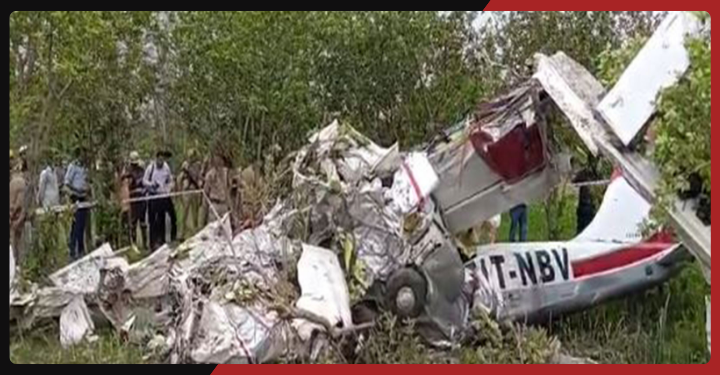

The fatal crash of a Garg Aviation training aircraft in Kanpur has renewed attention on safety procedures in India’s pilot-training sector. Two pilots, an instructor and a trainee, were killed when their twin-engine aircraft crashed near the Ganga Barrage on Thursday.
The aircraft was a Tecnam P2006T carrying registration VT-NBV. It crashed in an open field near Nathupurwa village. The aircraft was severely damaged in the impact, and police teams reached the location soon after the accident was reported.
Although training flights are designed to be conducted under controlled conditions, they involve many operational challenges. Trainees must learn to manage takeoffs, landings, navigation, aircraft handling and emergency procedures. Instructors supervise these activities and are expected to intervene whenever necessary.
The safety of such operations depends on several factors working together. Aircraft must be maintained according to regulatory requirements. Instructors and trainees must follow standard operating procedures. Weather conditions need to be assessed. Training exercises have to be planned within appropriate limits.
When an accident occurs, investigators therefore do not look at just one possible cause. They examine the entire chain of events.
In the Kanpur crash, that process is only beginning. Authorities have not yet established why the aircraft came down. There is no confirmed evidence at this stage that a technical failure, human error or weather caused the accident.
The Directorate General of Civil Aviation is investigating the crash. Investigators will examine the aircraft and records associated with the flight.
One potentially relevant detail is that the same aircraft registration, VT-NBV, was reported in an earlier incident at Kanpur’s Chakeri Airport in June. During that incident, a trainee pilot was injured by a running propeller while deboarding after a training flight. The regulator ordered an investigation into that event.
The existence of a previous incident does not prove that the aircraft was unsafe or that the two events were connected. Aircraft can be involved in incidents for many different reasons, and investigators must establish the facts separately.
Nevertheless, the latest crash is likely to lead to scrutiny of the aircraft’s maintenance history and operational records. Investigators may examine whether the aircraft had undergone required inspections and whether any defects had been reported before the fatal flight.
They will also need to determine the nature of the training flight. The aircraft was reportedly on a training sortie, meaning the flight was part of pilot instruction rather than a normal passenger operation.
The presence of an instructor is intended to provide an additional layer of safety. Instructors are trained to identify problems and take corrective action when necessary. However, some aviation emergencies can develop quickly, leaving little time to respond.
The crash also highlights the importance of emergency planning at flying training organisations. Training aircraft operate regularly, and schools need systems for dealing with aircraft emergencies, communication failures and unexpected landings.
For regulators, accident investigations provide an opportunity to identify weaknesses in existing procedures. If investigators find that a particular technical, operational or training issue contributed to the crash, corrective recommendations may follow.
The wider Indian aviation sector has experienced rapid growth in recent years, increasing the demand for pilots and therefore for flight-training capacity. Maintaining safety standards while expanding training operations is essential.
For aspiring pilots, flying schools are the first major stage of professional aviation. Their training shapes habits that pilots carry into later careers. Strong safety culture therefore has value beyond individual flights.
The Kanpur crash has resulted in the deaths of two people who were participating in that training system. Their loss is a reminder that pilot training is not merely an educational exercise but a form of aviation operation carrying real risks.
The exact cause of the crash will become clearer only after investigators examine the evidence. Until then, speculation should not replace verified information.
The immediate responsibility lies with the investigation team to establish what happened and determine whether any lessons can be applied to prevent another training aircraft from suffering a similar fate.
The Kanpur accident is therefore being watched closely not only because of the loss of two lives but also because of what its findings could mean for safety practices across India’s flight-training industry.


