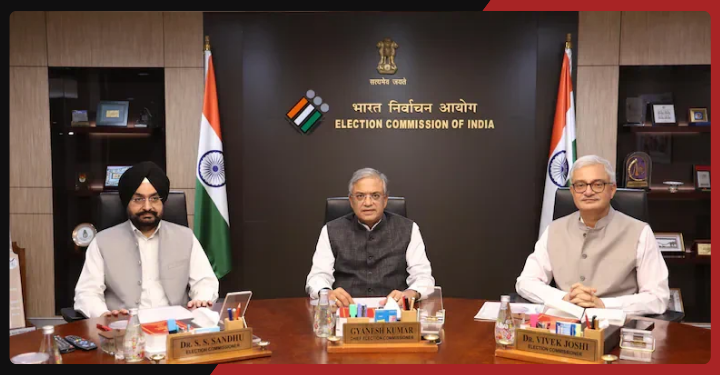

The controversy involving Chief Election Commissioner Gyanesh Kumar has raised an important institutional question: what does it mean when members of a constitutional commission record objections during internal deliberations?
The question has become central after reports that Election Commissioners Sukhbir Singh Sandhu and Vivek Joshi raised concerns multiple times over a period of 10 months.
According to The Indian Express, the objections involved several areas of the Election Commission’s functioning, including voter registration, deletion and restoration of names, changes involving Form 6 and electoral-roll data management.
The existence of these objections has been interpreted differently by different political actors.
Some critics have treated them as evidence of serious internal differences. The Election Commission, however, has said that individual opinions and objections form part of normal institutional deliberation.
In its clarification, the ECI stated that its members may express different views, make observations or offer technical suggestions while a matter is under consideration. It said that final decisions are institutional decisions and maintained that the Commission’s final decisions during the relevant period were unanimous.
This means that two separate questions need to be considered.
The first is whether differences occurred during discussions. Available reporting indicates that written objections were indeed recorded, according to the reports cited above.
The second question is whether those objections changed or invalidated final decisions of the Commission. The ECI’s answer is no: it maintains that the final decisions were unanimously approved.
This distinction is especially important in a three-member constitutional body.
Gyanesh Kumar currently heads the Commission, with Sandhu and Joshi serving as Election Commissioners.
The debate also involves the legal structure of the Election Commission. Recent explanations of the Commission’s functioning note that the CEC is the head of the institution, but the Commission operates as a multi-member body. Where members differ, the applicable framework provides for decision-making according to the rules governing the Commission rather than giving the CEC an unrestricted personal veto or unilateral authority.
That institutional structure makes the reported objections significant, but it also means that the precise details of each decision matter.
For example, an objection by one commissioner to a proposal is different from two commissioners jointly rejecting a final decision. Similarly, an internal suggestion about procedure is different from a formal legal challenge to the authority of the Commission.
The public debate has sometimes combined these separate issues, making the Commission’s clarification particularly relevant.
Another important element is the SIR exercise. The revision has involved extensive scrutiny of electoral rolls and has triggered debate over voter eligibility, discrepancies and the treatment of electoral data.
The Supreme Court has also recently examined aspects of the process in Delhi, including notices issued to voters over alleged “logical discrepancies.” The Court sought explanations regarding the basis and procedure for those notices.
The Election Commission has maintained that electoral-roll revision is necessary to preserve accurate voter lists.
The controversy therefore cannot be reduced to a simple disagreement between three officials. It involves questions about institutional procedure, electoral technology, voter registration and transparency.
As scrutiny continues, the most useful way to understand the dispute is to distinguish documented objections from interpretations of those objections and, separately, to examine the Commission’s final decisions.
The ECI has offered one clear institutional explanation: differing opinions can occur inside a multi-member body, but the Commission says its final decisions were unanimous.
Whether that explanation resolves public concerns will depend in large part on the Commission’s continuing willingness to provide detailed information about contested procedures and decisions.