
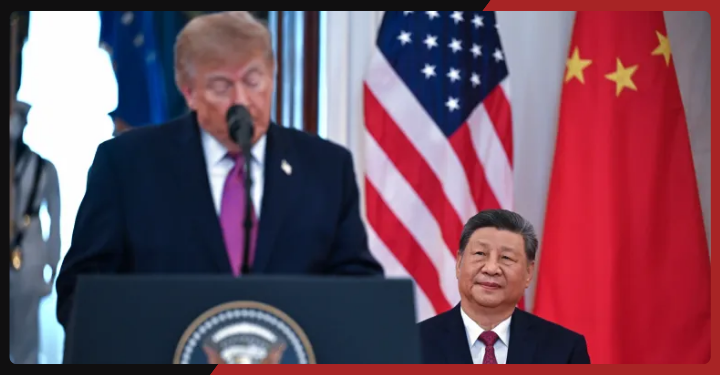

The US-China relationship is no longer limited to bilateral trade and technology. Global conflicts and geopolitical disputes increasingly affect the strategic calculations of Washington and Beijing.
The war involving Iran was therefore another important issue surrounding the Trump-Xi summit.
The United States has been directly involved in the conflict, while China has maintained important economic and diplomatic relationships with Iran. This creates different interests for Washington and Beijing.
The Trump administration has sought to exert pressure on Tehran, while Beijing has continued to maintain ties with Iran. Analysts have therefore watched closely to see whether China could play a role in diplomatic efforts connected to the conflict.
Before Xi’s Washington visit, Al Jazeera reported that the US-Israel war on Iran was expected to be among the issues discussed by the two leaders. The report also noted that Washington might hope Beijing could use its influence with Tehran, although Trump had indicated that he did not necessarily need Chinese assistance.
This difference is important.
For the United States, China’s relationship with Iran can be viewed as a potential source of diplomatic leverage. Beijing has economic connections with Tehran and maintains its own foreign-policy interests in the Middle East.
For China, however, involvement in the conflict would need to be considered alongside its wider strategic relationship with Washington, regional stability and energy security.
The Middle East is economically important to China because of its energy supplies and trade routes. Instability in the region can affect oil prices, shipping and broader global economic conditions.
The Strait of Hormuz is particularly significant because of its role in international energy transportation.
The United States and China therefore have different political approaches but share an interest in avoiding disruptions that could destabilise the global economy.
This creates a potential area where competing powers may still have common interests.
However, cooperation would not necessarily be easy. Washington and Beijing disagree over several aspects of international security, including the role of military force, sanctions and diplomatic pressure.
China has historically advocated diplomatic approaches and criticised certain American military interventions. The United States, meanwhile, has frequently used economic sanctions and military power as tools of foreign policy.
The Iran issue consequently provides another test of whether Washington and Beijing can manage disagreements while cooperating indirectly on areas of mutual concern.
It also demonstrates why the Trump-Xi relationship matters globally.
Decisions made in Washington and Beijing can influence events thousands of kilometres away. Economic measures, diplomatic statements and strategic agreements can affect governments across Asia, Europe and the Middle East.
For countries attempting to navigate the rivalry between the United States and China, this creates a difficult environment. Many governments want strong economic relations with both powers and do not want to be forced into choosing one side.
The summit therefore had implications beyond the immediate bilateral relationship.
The two leaders’ ability to discuss international crises directly can help reduce misunderstandings, even when their governments do not agree.
The Iran question remains unresolved, and there is no indication that the Washington meeting eliminated the differences between the United States and China regarding Tehran.
Nevertheless, the fact that such issues can be discussed at the highest level is significant.
The broader message from the summit is that US-China relations increasingly operate within a global framework. Trade, technology, Taiwan and Middle Eastern conflicts are interconnected parts of the same strategic relationship.
As a result, future US-China meetings will likely continue to address both bilateral disputes and major international crises.
