
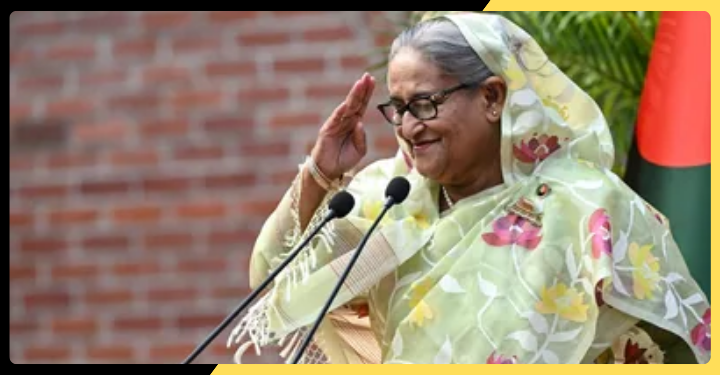

Bangladesh has formally approached India seeking clarification over reports that former Prime Minister Sheikh Hasina is preparing to deliver a speech from New Delhi, a development that has added a new layer of diplomatic sensitivity to relations between the two neighboring countries. The reported request comes at a time when Bangladesh continues to navigate a politically delicate transition, making any public appearance by the former leader a matter of significant interest both at home and abroad.
According to diplomatic sources, Dhaka communicated its concerns through established diplomatic channels after media reports suggested that Sheikh Hasina, who has been staying in India since leaving Bangladesh during the recent political upheaval, may soon address supporters from the Indian capital. While the exact details of the proposed event remain unclear, Bangladesh has reportedly sought to understand whether the Indian government has approved such an event and what its official position is regarding political activities conducted from its territory.
Neither India nor Bangladesh has publicly confirmed the diplomatic communication, and officials from both governments have refrained from making detailed comments. However, the reports have attracted considerable attention among political observers, who see the issue as an important test of diplomatic coordination between two countries that have maintained close ties for decades.
Sheikh Hasina’s continued presence in India has remained a politically sensitive subject ever since she left Bangladesh following widespread political unrest. India has consistently described her stay as being based on humanitarian considerations while avoiding public discussion about her political future or possible activities during her time in the country.
The reported plan for a public speech has nevertheless raised concerns in Dhaka. Officials are believed to be worried that a political address delivered from Indian territory could influence public opinion within Bangladesh or be interpreted as external involvement in the country’s domestic political affairs. The interim administration is reportedly keen to ensure that Bangladesh’s internal political processes remain free from outside influence.
Diplomatic experts point out that Bangladesh’s decision to seek clarification should not necessarily be interpreted as a sign of deteriorating relations. Instead, it reflects the normal functioning of diplomatic engagement between neighboring countries when politically sensitive issues arise. Direct communication allows governments to clarify intentions before misunderstandings develop into larger disputes.
India has traditionally maintained that it respects the sovereignty of neighboring nations and does not encourage activities on its soil that could interfere in another country’s domestic political matters. This long-standing principle has guided India’s foreign policy in similar situations involving political leaders from neighboring countries, and analysts believe it is likely to shape New Delhi’s response in the present case as well.
At the same time, India faces the challenge of balancing humanitarian considerations with diplomatic obligations. Sheikh Hasina remains a former head of government and an internationally recognized political figure, making any decision regarding her public engagements subject to close scrutiny.
The issue has drawn widespread attention because Sheikh Hasina continues to command substantial political influence in Bangladesh. As the longtime leader of the Awami League, her statements often carry significant political weight. Any speech delivered by her is likely to be closely followed by supporters, opponents, and international observers alike.
Political analysts suggest that the content of the proposed address will ultimately determine its diplomatic significance. If the speech focuses on personal reflections, appeals for peace, or messages directed primarily at supporters abroad, it may generate limited controversy. However, if it includes direct political criticism, commentary on Bangladesh’s current administration, or calls for political action, it could trigger stronger reactions.
Despite the current uncertainty, both India and Bangladesh have compelling reasons to preserve their close bilateral partnership. Over the years, the two countries have strengthened cooperation across multiple sectors, including trade, transportation, border security, energy, digital connectivity, defense, and disaster management. These shared interests have transformed the relationship into one of South Asia’s most important strategic partnerships.
Economic ties between the two nations continue to expand through growing bilateral trade and infrastructure projects that improve regional connectivity. Joint initiatives in railway development, road transport, inland waterways, electricity transmission, and cross-border energy cooperation have contributed to mutual economic growth.
Security cooperation has also become a cornerstone of bilateral relations. India and Bangladesh have worked together to address cross-border crime, terrorism, and illegal trafficking while improving coordination between security agencies. Such collaboration has strengthened trust and contributed to greater regional stability.
Foreign policy experts believe both governments are likely to handle the current issue through discreet diplomatic engagement rather than public confrontation. Quiet negotiations and mutual understanding have often characterized India-Bangladesh relations during previous periods of political sensitivity.
International observers are also monitoring the developments closely. Bangladesh occupies a strategically important position in South Asia and the Bay of Bengal region, while India considers stable relations with Dhaka essential for regional security and economic integration. Consequently, both governments are expected to avoid actions that could unnecessarily strain bilateral ties.
As of now, there is no official confirmation regarding the timing, venue, or nature of Sheikh Hasina’s reported speech. Similarly, neither government has announced any policy decision concerning the matter. Until formal statements are issued, much of the discussion remains based on diplomatic sources and media reports.
The coming days are expected to provide greater clarity as both New Delhi and Dhaka continue their diplomatic consultations. Regardless of how the issue develops, analysts believe the broader India-Bangladesh relationship is likely to remain resilient, supported by decades of cooperation and shared regional interests.