
India and Nepal have agreed to strengthen cross-border connectivity through new railway projects, bridges, petroleum infrastructure and additional trade routes following high-level discussions between Prime Minister Narendra Modi and Nepalese Prime Minister Balendra Shah.
The announcements were made during Shah’s two-day state visit to India from November 22 to 23, 2026. The visit focused on expanding economic cooperation and improving transportation links between the two neighbouring countries.
Connectivity remains an important part of India-Nepal relations because both countries share an extensive border and maintain close economic, cultural and social connections.
One of the important announcements during the visit was the progress made towards the proposed Raxaul-Kathmandu electrified broad-gauge railway line. The two leaders announced the finalisation of the field location survey for the project and agreed to cooperate in developing Nepal’s East-West Railway.
The Raxaul-Kathmandu railway project is expected to improve transportation between the two countries and create additional opportunities for passenger movement and commercial activity.
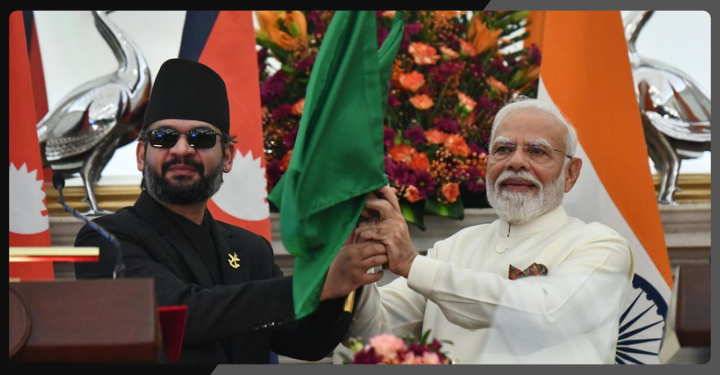
The leaders also flagged off the inaugural Sarayu-Kamala Express service connecting Ayodhya in Uttar Pradesh with Janakpur in Nepal. The railway connection is expected to strengthen religious and cultural tourism along the Ramayana Circuit.
Ayodhya and Janakpur hold special cultural significance for people in both countries because of their association with Lord Ram and Mata Sita.
The leaders also expressed interest in exploring similar connectivity initiatives for Buddhist and Shiv-Shakti religious tourism circuits.
Another important development was the inauguration of a new cross-border motorable bridge connecting Dharchula in India with Darchula in Nepal. The bridge is expected to improve direct connectivity between western Nepal and India.
The two leaders also virtually laid the foundation stone for a new Integrated Check Post at Banbasa. They welcomed progress in the construction of additional Integrated Check Posts at Bhairahawa, Sunauli and Dodhara-Chandani.
Integrated Check Posts are important for managing cross-border movement, facilitating trade and improving customs and immigration-related infrastructure.
Trade connectivity was another major focus of the discussions. Prime Minister Modi announced that Nepal would receive a new transit trade route through Deendayal Port in Gujarat. Access to Paradip Port in Odisha will also be provided once the necessary infrastructure is ready.
The additional port access is expected to give Nepal more flexibility in transporting goods through Indian territory.
Petroleum infrastructure also featured prominently in the announcements. Both leaders dedicated the second phase of the Motihari-Amlekhgunj petroleum pipeline to the people of Nepal.
They also laid the foundation stone for a petroleum terminal in Jhapa and emphasised the need to begin work on the proposed Siliguri-Jhapa petroleum pipeline at the earliest.
The two countries further agreed to explore cooperation in developing gas pipelines.
Civil aviation connectivity was also discussed. Both sides agreed that the existing unidirectional Kathmandu-Bhairahawa-Lucknow air route would be made bidirectional. Technical consultations will determine the implementation arrangements.
The two leaders also discussed improving border infrastructure through new railway lines, bridges and integrated facilities.
These projects form part of a larger joint vision aimed at strengthening economic cooperation and improving people-to-people connections.
For Nepal, improved access to Indian transportation infrastructure is particularly important for international trade because the country is landlocked. Better railway, road and port connectivity could reduce logistical challenges and create new opportunities for businesses.
For India, stronger connectivity with Nepal can support regional trade, tourism and economic integration.
The latest announcements represent an important step towards improving transportation infrastructure between the two countries. Their long-term impact will depend on timely construction, coordination between authorities and the successful completion of the proposed projects.