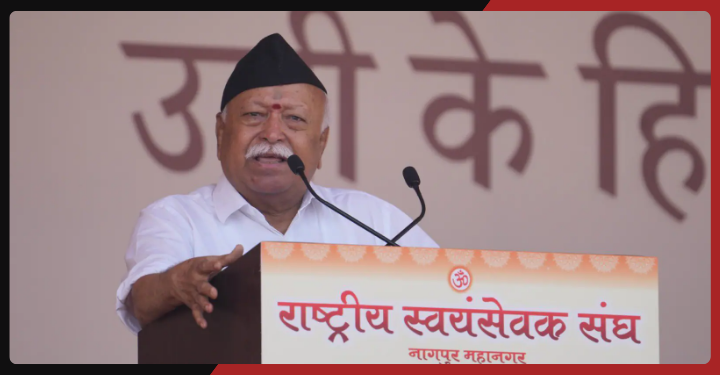

RSS chief Mohan Bhagwat has warned that international forces and domestic political interests could exploit disagreements within India to weaken the country. Addressing the organisation’s annual Vijayadashami gathering in Nagpur on October 20, 2026, he connected his concerns about political stability with developments in France, Albania, Bangladesh and Nepal. He argued that attempts to change political leadership do not necessarily resolve the problems that trigger public dissatisfaction.
Bhagwat’s remarks reflected his belief that India’s growing influence has made it a target for forces that may prefer the country to remain divided. He alleged that certain interests could encourage domestic tensions and use local political disagreements to pursue broader objectives.
These claims are significant because they frame internal political disputes as part of a wider international contest. However, allegations of foreign involvement require evidence. Public protests, political criticism and disagreements over government policy do not, by themselves, demonstrate the presence of an external operation.
India, like other democracies, faces the challenge of protecting its institutions while allowing citizens to participate in political debate. Governments must be able to investigate credible threats to national security, but such investigations should rely on verifiable information and established legal procedures.
The immediate context of Bhagwat’s remarks includes controversy surrounding protests over the Election Commission. The demonstrations have generated competing narratives about their purpose. Critics of the electoral process have raised questions about accountability, while some government supporters have suggested that the wider campaign could contribute to political instability.
These positions should be evaluated separately. Concerns about electoral procedures can be assessed through documentation, official explanations, independent scrutiny and judicial review where appropriate. Claims of a coordinated foreign effort require a different and more specific evidentiary basis.
Bhagwat’s warning also raises questions about the relationship between national unity and political disagreement. A country can maintain a strong national identity while allowing different political parties and social groups to disagree over public policy. In fact, peaceful competition can strengthen institutions by encouraging scrutiny and offering voters alternatives.
National unity is therefore not necessarily the absence of criticism. It can also mean agreement on constitutional rules, respect for lawful political participation and a willingness to resolve disputes without violence.
International examples can provide useful lessons, but comparisons must be handled carefully. Political unrest in France, Albania, Bangladesh or Nepal cannot automatically be attributed to a single cause, nor can the experience of one country predict what will happen in India. Each case involves its own history, institutions, economic conditions and public demands.
Bhagwat argued that India’s development and social strength would help prevent destabilising efforts from succeeding. His remarks placed confidence in national resilience and the capacity of society to resist attempts to deepen divisions.
For policymakers, the challenge is to turn that confidence into practical safeguards. These include transparent institutions, public access to information, effective grievance mechanisms and a political environment in which allegations can be investigated fairly.
For citizens, responsible engagement requires checking claims before sharing them and distinguishing documented facts from political assertions.
The broader issue raised by Bhagwat’s speech is how India can safeguard national interests without treating every disagreement as a security threat. A balanced approach must protect the country against genuine interference while preserving the democratic freedoms that allow citizens to question authority.