
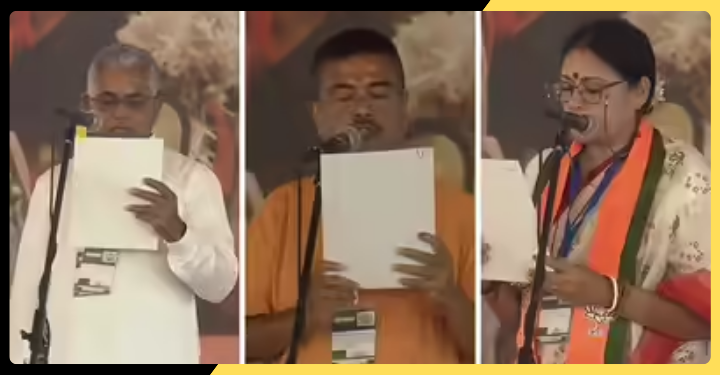

West Bengal entered a new political era after the Bharatiya Janata Party formed its first-ever government in the state. The cabinet led by Chief Minister Suvendu Adhikari includes a mix of veteran organisers and rising political faces, with Dilip Ghosh and Agnimitra Paul emerging as key names in the ministry.
For BJP supporters, Dilip Ghosh’s elevation is symbolic of the party’s long political journey in Bengal. At a time when the BJP had limited influence in the state, Ghosh worked extensively at the booth level and expanded the party’s presence across districts. His leadership during crucial elections helped BJP emerge as a principal challenger to the ruling Trinamool Congress.
Agnimitra Paul’s rise, meanwhile, reflects the BJP’s effort to cultivate a new generation of Bengali leaders. Before entering politics, Paul was known in the fashion industry, but over the past few years she has become an outspoken BJP voice on women’s rights, governance and political violence in Bengal.
The cabinet also features leaders such as Nisith Pramanik, Ashok Kirtania and Kshudiram Tudu. Their inclusion reflects BJP’s attempt to create a socially inclusive government representing different regions and communities of Bengal.
Observers note that the first cabinet is not merely administrative in nature but deeply political in design. Each minister represents a strategic constituency for the BJP, whether it is tribal belts, border districts, industrial towns or urban centres.
Prime Minister Narendra Modi’s presence at the oath ceremony added national attention to the event. The BJP leadership projected the victory as a major milestone in the party’s expansion into eastern India.
Despite the celebratory atmosphere, the new government faces immediate challenges. Bengal’s economy, unemployment concerns, industrial stagnation and political polarisation will test the cabinet’s ability to deliver governance beyond election slogans.
Still, the cabinet’s formation marks a defining chapter in Bengal politics. For the BJP, it is the culmination of years of organisational struggle. For Bengal, it signals the beginning of a new political experiment under saffron leadership.
