
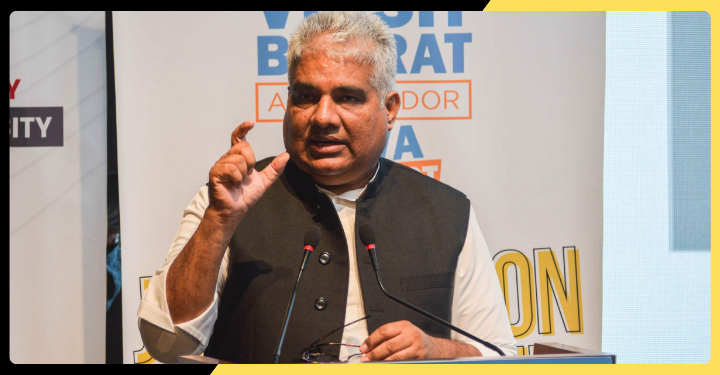

In a significant administrative move, the office of Union Minister Bhupender Yadav has undergone a major change following the removal of his Private Secretary and two Additional Private Secretaries. The personnel changes, which have attracted attention in government and bureaucratic circles, are being viewed as part of an internal administrative restructuring intended to strengthen the functioning of the minister’s office.
While no official statement has explained the specific reasons behind the decision, government sources indicate that such reshuffles are a normal feature of public administration. Ministries periodically review their administrative teams to ensure efficient governance, effective coordination, and smooth implementation of official responsibilities.
The Private Secretary to a Union Minister occupies one of the most important positions within the minister’s personal establishment. The officer serves as the principal point of coordination between the minister and various government departments, supervises official communication, manages confidential files, prepares meeting schedules, and ensures that administrative decisions are implemented without delay.
Supporting this role are the Additional Private Secretaries, who assist in handling official correspondence, coordinating with senior officers, preparing briefing notes, organizing meetings, and monitoring the movement of important files. Their work enables the minister’s office to function efficiently while managing a large volume of government business on a daily basis.
Officials familiar with the ministry’s functioning have emphasized that the latest personnel changes should not be interpreted as unusual. Similar administrative adjustments take place across ministries from time to time due to tenure completion, transfers, organizational restructuring, or evolving administrative requirements. Such changes are designed to maintain efficiency and introduce experienced officers into key support positions.
Bhupender Yadav, a senior member of the Union Council of Ministers, oversees responsibilities that require extensive coordination with multiple ministries, state governments, Parliament, and various public institutions. His office handles numerous official engagements every day, making an effective administrative support system essential for ensuring timely decision-making and smooth governance.
According to administrative experts, the efficiency of a ministerial office depends heavily on its support staff. While ministers formulate policies and make key decisions, officials in the personal secretariat ensure that these decisions are translated into administrative action through proper coordination, documentation, and communication. An experienced support team contributes significantly to maintaining continuity in government operations.
Government sources have confirmed that the ministry’s day-to-day functioning continues without disruption despite the recent personnel changes. Interim administrative arrangements have been made to ensure that official work proceeds as scheduled until permanent replacements are appointed. Routine file processing, parliamentary coordination, departmental meetings, and public communication remain unaffected during the transition.
The process of selecting new officers for these important positions is expected to begin shortly. Eligible officers with strong administrative experience and familiarity with government procedures are likely to be considered for appointment. Once selected, they will assume responsibility for managing the minister’s office and supporting the implementation of official policies and programmes.
Experts believe that periodic restructuring of ministerial offices reflects the government’s broader commitment to administrative accountability. Regular reviews help identify opportunities to improve coordination, strengthen institutional capacity, and adapt to changing governance priorities. Fresh appointments can also bring new administrative perspectives and enhance the overall efficiency of government operations.
Political observers have noted that personnel changes within ministerial offices frequently attract public attention because of the importance of these positions. However, they stress that such decisions are generally administrative in nature and should not automatically be linked to political developments unless supported by official confirmation.
The latest reshuffle underscores the importance of maintaining a responsive and well-organized ministerial secretariat. As governance becomes increasingly complex, ministers rely on experienced officers to coordinate policy matters, manage official communications, and ensure effective interaction with different branches of government.
The government is expected to announce new appointments in due course. Until then, the ministry remains fully operational, with officials continuing to perform their duties under established administrative procedures. The transition is expected to be completed smoothly, reinforcing the government’s objective of maintaining efficient, transparent, and accountable administration while ensuring uninterrupted delivery of public services.
