
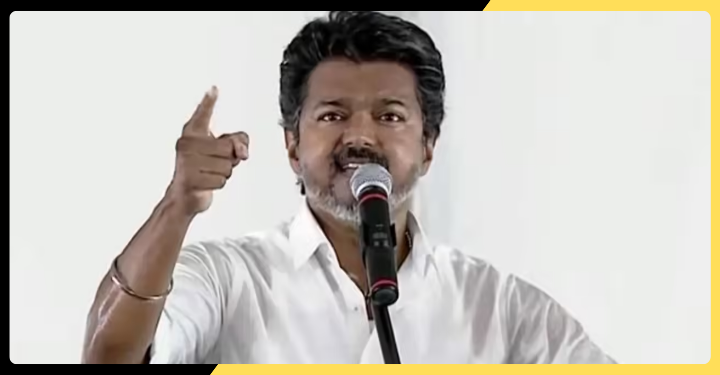

Tamil Nadu’s political landscape has witnessed a seismic transformation in the 2026 Assembly election results, with actor-turned-politician Vijay and his Tamilaga Vettri Kazhagam (TVK) emerging as the biggest story of the election season. What began as a celebrity-led political experiment has now evolved into a full-scale political movement that has shaken the decades-old dominance of the DMK and AIADMK. Early trends and counting updates indicate that TVK has surged past the 100-seat mark, turning the state into the epicentre of what supporters are calling the “Purple Wave.”
From the beginning of the campaign, Vijay positioned himself as the face of political change. His speeches focused on unemployment, corruption, rising living costs, and the frustrations of young voters who felt disconnected from traditional Dravidian politics. Unlike established parties that relied heavily on alliances and caste arithmetic, TVK campaigned aggressively on emotional appeal, youth energy, and anti-establishment messaging.
As counting began on Monday morning, the DMK initially held a narrow advantage through postal ballots. However, within hours, the momentum dramatically shifted. TVK rapidly climbed from single-digit leads to overtaking both the DMK and AIADMK across major constituencies. By late morning, TVK was leading in more than 100 seats, while the ruling DMK slipped into third place in several rounds of counting.
One of the most symbolic moments of the election came when Chief Minister M.K. Stalin reportedly trailed in his Kolathur constituency during early counting rounds. Though leads continued to fluctuate, the visuals and headlines reflected the scale of the political upheaval underway.
The “Vijay Effect” extended far beyond urban centres. TVK performed strongly in semi-urban belts, youth-dominated constituencies, and areas where voters expressed fatigue with traditional party structures. Analysts noted that Vijay’s cinema fan clubs played a major organizational role on the ground, functioning as booth-level campaign units during polling. Social media campaigns amplified TVK’s message and helped create a sense of momentum unmatched by rival parties.
Celebrations erupted outside TVK headquarters in Chennai as supporters waved purple party flags and chanted slogans hailing Vijay as Tamil Nadu’s next political icon. Videos circulating online showed supporters comparing his rise to that of legendary actor-politicians like M.G. Ramachandran and Jayalalithaa, both of whom transformed Tamil Nadu politics in earlier decades.
For the DMK, the results represent a serious political setback despite entering the election with the advantages of incumbency, welfare delivery, and organizational strength. The AIADMK-BJP alliance also struggled to capitalize on anti-incumbency sentiments, as a large section of floating voters appeared to consolidate behind TVK instead.
Political observers believe this election may permanently alter Tamil Nadu’s traditional two-party system. For more than five decades, power largely alternated between the DMK and AIADMK. Vijay’s emergence has disrupted that cycle and introduced a new political force with statewide appeal.
Even as counting continues and final results are awaited, one conclusion is already unavoidable: Vijay is no longer merely a cinema superstar. With TVK’s dramatic debut, he has become one of the most influential political figures in Tamil Nadu today, and the 2026 election may well be remembered as the moment a new era of state politics truly began.