
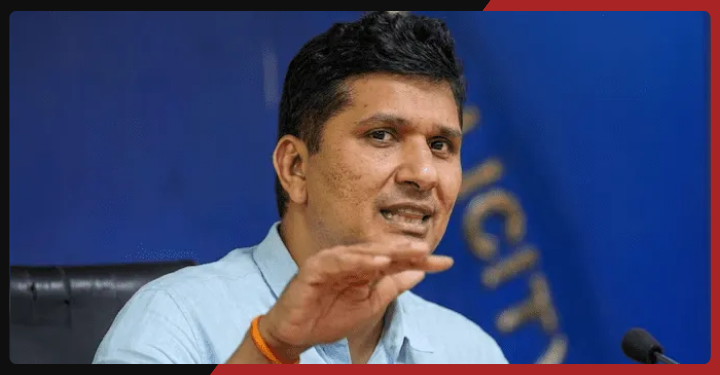

Aam Aadmi Party leader Saurabh Bharadwaj launched a strong political attack on the Bharatiya Janata Party after Delhi Lieutenant Governor V K Saxena ordered the recovery of ₹97 crore over advertisements issued by the Delhi government.
Bharadwaj questioned why the AAP-led Delhi administration was being targeted when, according to his claim, BJP-ruled states had spent around ₹22,000 crore on advertisements. He asked BJP national president J P Nadda to explain when that money would be returned to government exchequers.
The controversy reflected the increasingly bitter political relationship between the AAP and BJP.
The immediate issue involved government advertising. Authorities had alleged that certain advertisements issued by the Delhi government violated guidelines because they functioned as political publicity rather than neutral communication about government schemes.
The Lieutenant Governor’s office directed the Chief Secretary to recover the money.
AAP leaders rejected the decision and accused the Lieutenant Governor of acting beyond his authority. Bharadwaj described the order as politically motivated and argued that advertisements issued by governments routinely appear in media outlets outside their geographical jurisdictions.
According to reports, he pointed to advertisements from various states appearing in Delhi and argued that if such advertising was considered legitimate elsewhere, the Delhi government’s publicity campaigns should not be singled out.
The ₹22,000-crore figure was used by Bharadwaj to challenge the BJP politically. He said BJP-ruled states had spent approximately that amount on advertisements and questioned why the party was demanding ₹97 crore from AAP.
The statement immediately attracted attention because of the enormous difference between the two figures.
However, the two amounts arose from different contexts. The ₹97 crore figure was connected to the Delhi government’s alleged violation of advertising guidelines. The ₹22,000 crore figure was Bharadwaj’s estimate of advertising expenditure by governments ruled by the BJP.
There is no evidence in the sources reviewed establishing the ₹22,000 crore as a confirmed scam.
Government advertising has been a contentious issue in India for years. Publicity is necessary for many government programmes, particularly those involving health, education, welfare and public safety. But government advertising can also be criticised when it gives excessive prominence to political leaders.
The Supreme Court has laid down guidelines intended to ensure that taxpayer-funded advertisements serve a public purpose rather than becoming instruments of political promotion.
The Delhi controversy emerged against this background.
The AAP argued that the government’s advertisements were intended to communicate information about public initiatives. The authorities questioned whether some of those campaigns crossed the boundary into political advertising.
Bharadwaj’s counterargument was based on consistency. He maintained that if the Delhi government was being questioned for advertisements appearing outside Delhi, other governments that advertise outside their states should also face scrutiny.
The argument became particularly political because national newspapers and television channels have audiences across India. A government in one state can therefore reach citizens in another state through advertising.
At the same time, critics of such spending can ask whether taxpayers in one state should finance publicity aimed primarily at audiences elsewhere.
These questions are not limited to Delhi. They concern all state governments and the Union government.
The controversy also showed the importance of clear accounting. Advertising expenditure should ideally be disclosed in a manner that allows citizens and auditors to determine how much was spent, where it was spent and what purpose the campaign served.
The political battle between AAP and BJP turned these administrative questions into competing accusations.
Bharadwaj presented the ₹22,000-crore figure as evidence of what he described as a double standard. The BJP’s criticism of Delhi’s advertising spending, from the AAP’s perspective, was part of a broader political campaign against the party.
The Lieutenant Governor’s action, however, was presented as an accountability measure related to public money.
For a balanced understanding, both the allegation and its evidentiary status need to be made clear. Bharadwaj made the ₹22,000-crore claim; it should not be reported as a judicially established scam.
The dispute ultimately highlights a central democratic principle: public money must be spent transparently and according to established rules, regardless of which political party is in power.
The controversy surrounding the ₹97 crore recovery order and Bharadwaj’s ₹22,000-crore counterclaim therefore became another chapter in the long-running AAP-BJP political battle over governance, accountability and control of Delhi’s administration.