
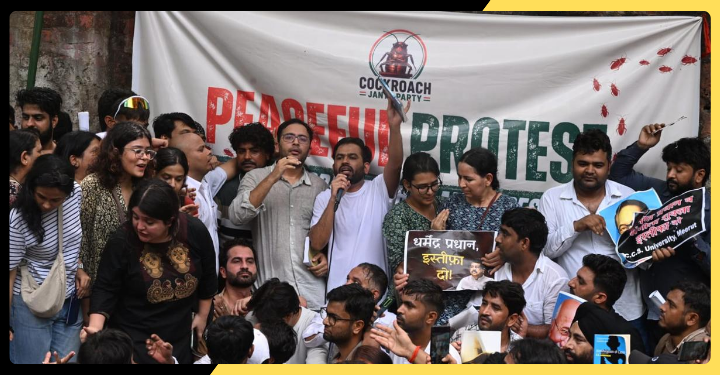

A large gathering of students and youth activists assembled at Jantar Mantar in New Delhi as part of a protest organized under the banner of the Cockroach Janta Party. The demonstration attracted participants from various educational institutions and social organizations, all united by a common goal of raising awareness about issues affecting young people. The event gained additional attention when social activist Abhijeet Dipke joined the protest and addressed the crowd.
The protest began early in the day, with students arriving from different parts of the city carrying banners, posters, and placards. The messages displayed reflected concerns related to education, employment opportunities, social justice, and governance. Organizers stated that the objective of the demonstration was to provide a platform for youth voices and encourage meaningful public discussion about challenges faced by students and young professionals.
As the crowd continued to grow, the atmosphere at Jantar Mantar became increasingly energetic. Participants chanted slogans, engaged in discussions, and listened to speeches delivered by activists and community representatives. Many attendees expressed the belief that young people should have a stronger voice in decisions that directly affect their future.
One of the key moments of the day came with the arrival of Abhijeet Dipke. His presence was welcomed enthusiastically by the protesters, many of whom viewed his participation as a sign of support for youth-led movements. Addressing the gathering, Dipke stressed the importance of peaceful democratic engagement and encouraged students to remain active in civic affairs.
During his speech, Dipke emphasized that students have historically played an important role in driving social and political change. He noted that youth participation is essential for a healthy democracy and urged attendees to continue raising issues through constructive and lawful means. According to him, public dialogue and active citizenship are necessary for addressing challenges and improving governance.
The demonstration featured a variety of speakers representing different student groups and organizations. Several speakers highlighted concerns about educational opportunities, skill development, and employment prospects. Others focused on broader social issues, arguing that greater public participation is necessary to ensure that policies reflect the needs of younger generations.
Participants described the event as an opportunity to connect with like-minded individuals and share experiences. Many students said they appreciated having a space where they could openly discuss challenges and potential solutions. Some attendees also expressed hope that the protest would encourage policymakers to engage more closely with youth concerns.
Despite the large turnout, the gathering remained peaceful and organized. Volunteers worked throughout the day to assist participants, coordinate activities, and maintain order. Organizers repeatedly reminded attendees to follow established guidelines and conduct themselves responsibly.
The protest also generated significant attention on social media platforms. Images and videos from Jantar Mantar were shared widely, helping to expand the conversation beyond those physically present at the event. Hashtags related to the demonstration gained traction online as supporters and observers discussed the issues raised by participants.
Political observers noted that youth-centered demonstrations have become increasingly visible in recent years. Many believe that students are becoming more engaged in public affairs and more willing to participate in discussions about policy and governance. Such events, they argue, reflect a growing awareness among young citizens about their role in shaping society.
For many attendees, the protest represented more than a single day of activism. It was viewed as part of a broader effort to encourage civic engagement and strengthen democratic participation. Students emphasized that raising awareness is often the first step toward achieving meaningful change and ensuring that public concerns receive attention.
As the event progressed, participants continued to express their views through speeches, discussions, and symbolic demonstrations. The atmosphere remained focused on dialogue and collective action rather than confrontation. Organizers thanked attendees for their support and reiterated their commitment to advocating for youth-related issues.
By the end of the day, the protest had succeeded in attracting public attention and generating discussion around the concerns highlighted by students and youth groups. While the long-term impact of the demonstration remains uncertain, the event underscored the determination of young citizens to engage with important social and political issues.
The gathering at Jantar Mantar serves as a reminder of the enduring significance of democratic participation and peaceful protest. With figures such as Abhijeet Dipke lending support and students taking the lead in public discussions, the event showcased the growing influence of youth voices in contemporary civic life. The protest may have concluded, but the conversations it sparked are likely to continue in the days and weeks ahead.
