
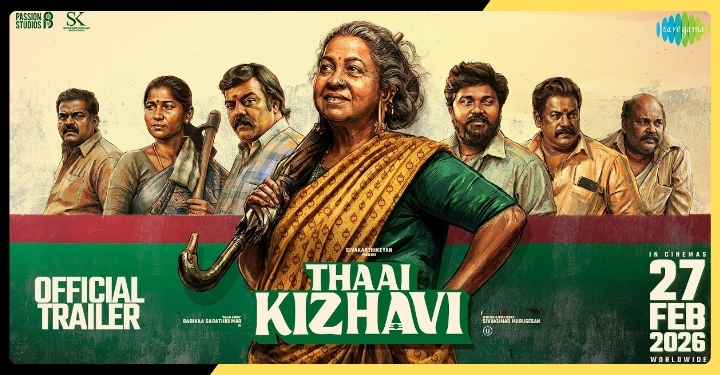

Few commercial entertainers dare to centre their spectacle on an ageing woman who refuses invisibility. “Thaai Kizhavi” does precisely that — and in doing so, announces a filmmaker unafraid of blending tradition with audacity. The result is a masala comedy that feels both comfortingly familiar and bracingly assertive.
The film opens with flourish: ceremonial rituals, bustling household staff and the unmistakable aura of wealth. At the helm stands the matriarch, orchestrating daily operations with military precision. From the outset, the direction emphasises hierarchy through blocking and camera placement. She is framed as the axis around which chaos spins.
Conflict arises when succession becomes unavoidable. The matriarch’s reluctance to relinquish control clashes with her heirs’ eagerness to redefine the family enterprise. Rather than treating this as purely dramatic fodder, the film mines it for humour. Power struggles unfold through elaborate misunderstandings, overheard conversations and strategic displays of exaggerated respect.
The director’s most notable achievement lies in tonal calibration. Comedy does not trivialise emotional stakes; instead, it sharpens them. When betrayals surface, they sting. When reconciliations occur, they feel earned. The film’s emotional architecture rests on the understanding that authority within families is both protective and oppressive.
Production design revels in opulence. Gold-toned lighting bathes interiors in warmth, creating a visual metaphor for prosperity that borders on surreal. Yet amid the extravagance, intimate close-ups remind viewers that beneath the regalia lies vulnerability. The matriarch’s solitary moments — removing jewellery at night, reflecting in silence — puncture the spectacle with humanity.
Supporting performances inject vitality. Siblings bicker with comic timing; spouses offer sly commentary; grandchildren oscillate between admiration and rebellion. These dynamics prevent the narrative from becoming monolithic. Instead, the household feels textured, alive with competing desires.
The screenplay also gestures toward broader social commentary. Questions of gendered authority surface subtly. The matriarch’s dominance challenges expectations about ageing and female leadership within patriarchal frameworks. Her insistence on visibility becomes, in effect, a political act — though the film wisely avoids didacticism.
Musical interludes amplify thematic tensions. Upbeat numbers celebrate continuity, while softer melodies underscore generational anxiety. The choreography often positions the matriarch at the centre, reinforcing her symbolic status even in moments of communal festivity.
If the film occasionally indulges in melodramatic crescendos, it does so knowingly. Raised voices, dramatic pauses and swelling background scores are deployed with a wink, acknowledging genre conventions while embracing them wholeheartedly.
By the climax, the narrative converges on a choice: cling to absolute control or cultivate shared stewardship. The resolution avoids simplistic moralising. Instead, it suggests that legacy is strongest when it adapts. The matriarch’s final gesture — equal parts concession and assertion — encapsulates the film’s philosophy.
“Thaai Kizhavi” ultimately succeeds because it trusts its central character’s complexity. She is commanding yet compassionate, strategic yet sentimental. Through her, the film argues that age does not diminish narrative centrality. On the contrary, experience can be the most dynamic engine of storytelling.
As a calling card for its director, the film signals confidence in blending mass appeal with character focus. It honours masala traditions — colour, music, heightened emotion — while carving space for a protagonist rarely afforded such flamboyant authority. In its gleaming surfaces and grounded heart, the film finds a balance that feels both celebratory and quietly radical.
