
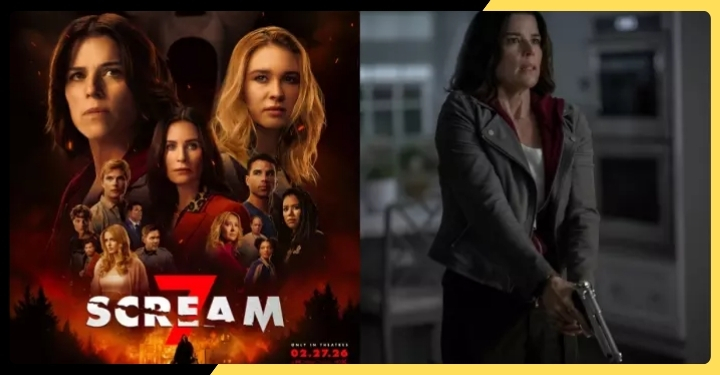

With every new installment, the Scream franchise faces the same daunting question: how do you keep a meta-slasher fresh in a horror landscape it helped redefine? Scream 7 attempts to answer that question by bringing back its most iconic survivor while doubling down on brutality and legacy storytelling. The result is a film that is emotionally grounded and occasionally gripping, yet uneven in its execution — a sequel that satisfies in moments but divides in impact.
The most headline-worthy development is the return of Neve Campbell as Sidney Prescott. After her absence from the previous entry, her reappearance feels less like fan service and more like narrative necessity. Sidney has always been the emotional spine of the franchise — not merely a “final girl,” but a symbol of resilience forged through trauma. In this chapter, she is older, more guarded, and fiercely protective of her family. The film leans heavily into the idea of generational trauma, exploring whether the sins of the past can ever truly remain buried.
The setting plays a crucial thematic role. Returning once again to Woodsboro, the story frames the town as both birthplace and battleground — a place where violence is cyclical and memory lingers in every quiet street. This homecoming amplifies the emotional stakes. The suburban calm contrasts sharply with the chaos unleashed by a new Ghostface, reinforcing how horror in this universe thrives in familiar spaces.
Behind the camera is Kevin Williamson, whose involvement marks a creative full-circle moment. As the writer of the original Scream, Williamson understands the franchise’s DNA better than most. His direction captures flashes of the series’ original wit, particularly in scenes where characters debate horror conventions or comment on sequel fatigue. Yet the satire here feels less incisive than before. Rather than dismantling modern horror tropes, the film sometimes seems content to reference them without deeper critique.
Of course, no discussion of Scream 7 would be complete without addressing Ghostface. The masked killer remains a potent cinematic image — the elongated mask, the black robe, the chilling voice on the phone. In this entry, Ghostface is portrayed as more relentless and physically imposing. The violence is intense, occasionally shocking, and staged with technical precision. One standout sequence in a dimly lit house delivers genuine suspense, reminding audiences why the formula worked so well in the first place.
However, the mystery element — historically the franchise’s secret weapon — proves somewhat less effective. Part of the thrill of a Scream film lies in guessing the killer’s identity, weighing motives, and second-guessing every suspicious glance. While Scream 7 includes its share of red herrings, the eventual reveal lacks the jaw-dropping audacity of earlier installments. The twist is coherent, but it doesn’t entirely reframe the narrative in a way that feels revelatory.
Courteney Cox reprises her role as Gale Weathers, bringing sharp energy and seasoned gravitas to the screen. Gale’s character arc continues to evolve in subtle ways, reflecting a woman who has survived both professional ambition and personal loss. Her scenes with Sidney are among the film’s strongest, grounded in shared history and unspoken understanding. These interactions provide emotional texture that offsets the relentless violence.
The supporting cast of younger characters injects urgency and unpredictability into the story, though not all are equally developed. Some serve primarily as potential victims or suspects rather than fully fleshed-out individuals. This imbalance occasionally weakens the suspense; without strong emotional investment, certain deaths feel more shocking than devastating.
Technically, the film excels. The cinematography favors shadows and tight framing, creating a claustrophobic atmosphere that enhances tension. The score underscores key moments without overwhelming them, allowing silence to become an instrument of dread. These elements combine to produce sequences that are undeniably effective on a visceral level.
Where the film falters is in thematic cohesion. It introduces compelling ideas — inherited trauma, media sensationalism, the commodification of tragedy — but doesn’t fully commit to exploring them. Instead, the narrative often defaults to familiar slasher rhythms. This adherence to formula is both comfort and constraint. Longtime fans may appreciate the structural consistency, while others may yearn for a more daring reinvention.
In the end, Scream 7 stands as a testament to the franchise’s endurance. Sidney Prescott’s return adds emotional authenticity, and the film’s technical craft ensures that Ghostface remains a formidable cinematic presence. Yet the divided reaction it is likely to inspire stems from its cautious approach. It honors its legacy with sincerity but stops short of radically redefining it.
For audiences seeking nostalgia, suspense, and a reunion with beloved characters, this installment delivers enough to justify its existence. For those hoping the series would once again revolutionize horror as it did decades ago, the scares may feel more familiar than transformative. Scream 7 proves that while Sidney can survive almost anything, sustaining true innovation is the franchise’s most difficult challenge of all.
