
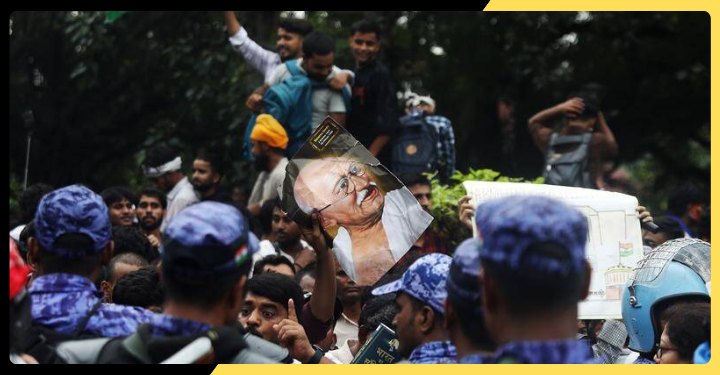

Thousands of supporters of the fictional “Cockroach Movement” gathered in India’s capital on Monday for a large public demonstration that culminated in an attempted march toward Parliament. The event, organized by movement leaders weeks in advance, drew participants from multiple states and attracted widespread attention from residents, media organizations, and government officials.
Crowds began assembling early in the morning at a designated protest site in central New Delhi. Many participants traveled overnight by buses, trains, and private vehicles to attend the rally. Volunteers welcomed arrivals, distributed information leaflets explaining the movement’s objectives, and guided supporters toward assembly areas where speeches were scheduled throughout the day.
The demonstration featured banners, placards, and flags carrying the movement’s symbols and messages. Protesters chanted slogans supporting peaceful civic participation and called for greater dialogue between citizens and policymakers. Organizers repeatedly reminded participants that the rally was intended to remain peaceful and urged everyone to follow the instructions of law enforcement authorities.
“Our purpose today is to make our voices heard through democratic and lawful means,” one organizer told the gathering. “Peaceful participation is at the heart of our campaign, and we encourage every supporter to act responsibly throughout the event.”
In anticipation of the demonstration, authorities deployed a significant number of police officers around Parliament and other government buildings. Security measures included barricades, traffic diversions, surveillance teams, and designated protest routes. Officials stated that these arrangements were designed to maintain public order while protecting sensitive government institutions.
As speeches concluded late in the morning, organizers led supporters along the approved march route toward Parliament. The procession moved steadily through central Delhi, with volunteers helping maintain orderly lines and ensuring emergency access routes remained clear. Police officers accompanied the march and monitored the situation from nearby intersections.
When demonstrators approached the security perimeter surrounding Parliament, they were stopped at a series of barricades established by police. Senior officers informed organizers that further movement toward the Parliament complex would not be permitted because of standing security regulations governing restricted areas.
Movement representatives held discussions with police officials before announcing that participants would remain peaceful and respect the restrictions. Organizers encouraged supporters to gather near the barricades instead of attempting to cross them, emphasizing that cooperation would help preserve the peaceful nature of the event.
A delegation of representatives was later allowed to submit a written memorandum through official administrative channels. The document summarized the movement’s concerns and requested that elected representatives consider additional opportunities for public consultation on national issues.
Throughout the afternoon, volunteers distributed bottled water, snacks, and medical assistance to participants. Healthcare teams treated several people for dehydration and fatigue caused by the warm weather, but authorities reported no serious injuries. Police confirmed that the gathering remained orderly, with no significant incidents of violence or property damage.
The rally attracted considerable public interest. Residents watched from nearby sidewalks and office buildings, while journalists interviewed participants and observers about the demonstration. Some citizens expressed support for the protesters’ right to peaceful assembly, while others voiced concerns about temporary traffic congestion and disruptions to daily travel.
Traffic police implemented alternate routes to ease congestion around the protest area. Although several major roads experienced delays, officials said the diversions helped maintain the flow of emergency vehicles and public transportation throughout the day.
Political analysts noted that peaceful demonstrations continue to play an important role in democratic societies by providing citizens with opportunities to express differing opinions. They also observed that cooperation between organizers and authorities contributed to the calm atmosphere during the event.
As the afternoon came to a close, movement leaders thanked participants for maintaining discipline and announced the conclusion of the demonstration. Volunteers collected litter and dismantled temporary facilities before supporters gradually dispersed from the area.
Police reopened affected roads during the evening and confirmed that normal traffic had resumed across central Delhi. Organizers described the fictional rally as a success, saying it demonstrated the movement’s commitment to peaceful advocacy and constructive dialogue.
Although supporters did not reach Parliament itself, the demonstration concluded without major incidents, reinforcing the importance of lawful public participation, mutual respect, and open communication in a democratic society.