
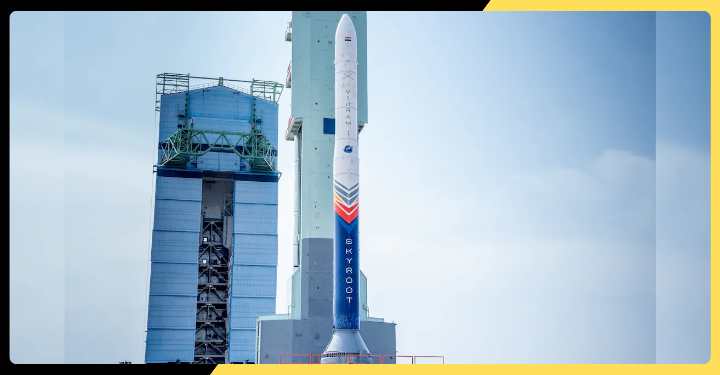

The successful orbital launch of Vikram-1 has marked a historic milestone for Skyroot Aerospace and India’s fast-growing private space sector. The achievement showcases the country’s expanding technological capabilities and demonstrates that Indian startups can develop sophisticated launch vehicles capable of reaching space. However, while the successful mission has generated excitement among investors, policymakers, and the scientific community, it also highlights an important reality of the commercial space industry: reaching orbit is only the beginning. Building a profitable and sustainable business remains one of the most difficult challenges facing any private launch company.
For decades, space exploration was largely dominated by government agencies with significant financial support and long-term national objectives. Today, the industry has evolved into a competitive commercial marketplace where private companies compete for satellite launch contracts, research missions, and defense-related projects. In this environment, engineering excellence must be matched by sound business strategy, financial discipline, and operational efficiency.
Skyroot Aerospace has already demonstrated remarkable technological progress. Founded by former Indian Space Research Organisation (ISRO) engineers, the company set out to develop affordable launch vehicles capable of serving the growing global small satellite market. Its emphasis on lightweight composite structures, advanced propulsion systems, and 3D-printed rocket components reflects a modern approach to rocket manufacturing aimed at reducing costs while maintaining high performance.
The Vikram-1 mission validates years of research, design, and testing. Successfully placing a rocket into orbit is one of the most complex engineering tasks in the aerospace industry. Every stage of the mission—from ignition and stage separation to orbital insertion—requires extraordinary precision. Completing such a mission proves that Skyroot possesses the technical capability to compete in an increasingly sophisticated global market.
Yet technological capability alone does not ensure commercial success. Investors and customers are primarily interested in consistency. Satellite operators want launch providers that can deliver payloads safely, reliably, and on schedule. One successful launch creates confidence, but multiple successful missions establish credibility. Skyroot must therefore focus on building a reliable launch record that demonstrates operational excellence over time.
Launch frequency will become another key performance indicator. A company that conducts only occasional launches cannot generate sufficient revenue to sustain long-term operations. Commercial customers prefer providers with predictable launch schedules because satellite deployment often supports critical business operations, scientific research, and government programs. Increasing the number of annual launches while maintaining quality and safety standards will be essential for Skyroot’s financial growth.
Profitability also depends on managing costs effectively. Rocket development involves substantial investments in manufacturing facilities, propulsion systems, testing infrastructure, quality assurance, regulatory compliance, and skilled personnel. Even after achieving orbital capability, continuous improvements in production efficiency are necessary to remain competitive. Companies that successfully reduce manufacturing costs while maintaining reliability gain a significant advantage in attracting customers.
The international competitive landscape is becoming increasingly crowded. Established launch providers have already developed strong customer relationships, completed numerous commercial missions, and invested in reusable launch technologies that lower operational costs. Reusability has transformed the economics of space transportation by reducing the cost of launching satellites into orbit. While Skyroot currently focuses on expendable launch vehicles, future technological innovations may determine its ability to compete in a changing marketplace.
One of Skyroot’s strongest opportunities lies in the rapidly expanding small satellite sector. Advances in miniaturization have enabled satellites to perform complex tasks despite their compact size. These satellites support telecommunications, Earth observation, navigation, agriculture, disaster management, defense, and environmental monitoring. As governments and private companies deploy large satellite constellations, demand for flexible and dedicated launch services is expected to continue rising.
Dedicated launch vehicles offer important advantages over rideshare missions. Customers can select specific launch dates and orbital destinations without depending on the schedules of larger rockets carrying multiple payloads. This flexibility makes dedicated launch providers particularly attractive for commercial operators with time-sensitive missions.
Government support has played a crucial role in enabling India’s private space ecosystem. Regulatory reforms have encouraged startups to participate in launch services, satellite manufacturing, and space technology development. Access to testing facilities, launch infrastructure, and collaboration opportunities with national space institutions has lowered barriers for emerging companies. These reforms have also attracted domestic and international investors seeking opportunities in India’s expanding space economy.
However, financial sustainability requires more than supportive policies. Investors increasingly expect measurable business performance, including recurring revenue, expanding customer portfolios, operational scalability, and healthy profit margins. Future funding will depend on Skyroot’s ability to demonstrate commercial momentum alongside technological innovation.
Diversification could strengthen the company’s long-term prospects. In addition to launch services, Skyroot may explore satellite deployment solutions, spacecraft propulsion technologies, orbital logistics, mission planning, and in-space servicing. Expanding into complementary business areas could reduce dependence on launch revenue while creating stronger customer relationships.
Building a resilient supply chain will also be essential. Rocket manufacturing depends on thousands of precision-engineered components sourced from specialized suppliers. Ensuring consistent quality, timely deliveries, and efficient production processes becomes increasingly important as launch frequency increases. Any disruptions in the supply chain could delay missions and affect customer confidence.
The successful Vikram-1 mission has undoubtedly established Skyroot Aerospace as one of India’s leading private space companies. It demonstrates that Indian startups possess the talent, innovation, and determination to compete internationally. Nevertheless, the transition from engineering success to commercial profitability remains one of the industry’s greatest challenges.
Skyroot’s orbital milestone represents more than a successful rocket launch—it symbolizes the emergence of India’s private space economy. The company’s next objective is to transform this technological achievement into a financially sustainable enterprise capable of delivering reliable launch services, expanding internationally, and contributing to the global space industry. If Skyroot succeeds in this mission, it will not only secure its own future but also help shape India’s position as a leading force in commercial space exploration.
