
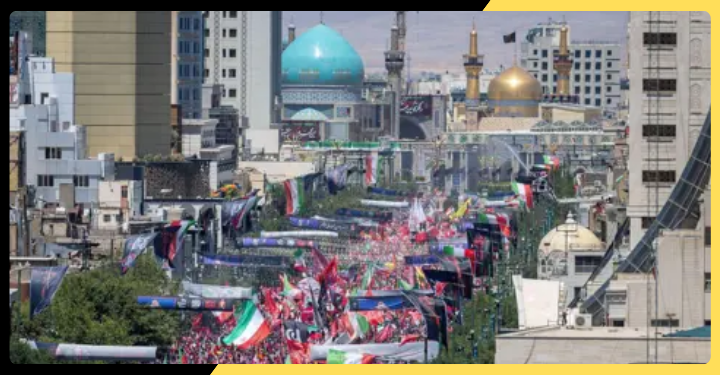

Mashhad, Iran: Hundreds of thousands of mourners gathered in the northeastern Iranian city of Mashhad as the country concluded a week-long series of funeral ceremonies for its late Supreme Leader, Ayatollah Ali Khamenei. The burial at the Imam Reza Shrine marked the final stage of nationwide mourning that included memorial events in Tehran, Qom, and the Iraqi holy cities of Najaf and Karbala before returning to Khamenei’s hometown of Mashhad.
From the early hours of the morning, major highways leading into Mashhad were crowded with buses, private vehicles, and organized convoys transporting mourners from across Iran. Hotels and guesthouses reached capacity as thousands of visitors arrived to participate in the final farewell. Authorities introduced special transportation services and traffic restrictions to manage the unprecedented influx of people into the holy city.
The streets surrounding the Imam Reza Shrine became filled with black mourning banners, Iranian flags, and portraits of the late leader. Many participants carried flowers while others held copies of the Quran during the funeral procession. Religious chants and prayers echoed through the city as mourners lined the carefully planned route leading to the shrine.
Security remained exceptionally tight throughout the ceremony. Thousands of police officers, members of the Islamic Revolutionary Guard Corps, and emergency response personnel were deployed across Mashhad. Security checkpoints were established around the shrine, while surveillance systems monitored crowd movements to ensure the safety of participants. Medical teams and Red Crescent volunteers also remained on standby to provide assistance to anyone requiring emergency care.
Senior Iranian officials, military commanders, religious scholars, and foreign delegations attended the burial ceremony. Funeral prayers were led by prominent clerics before the coffin was transferred into the Imam Reza Shrine for its final resting place. The event was broadcast live on national television, allowing millions of Iranians unable to travel to Mashhad to follow the historic ceremony from their homes.
Throughout the funeral, speakers praised Ayatollah Khamenei’s decades of leadership, highlighting his influence on Iran’s political institutions, religious establishment, and regional policies. Officials called on citizens to remain united during the country’s leadership transition and emphasized the importance of preserving national stability amid continuing regional tensions.
The burial site carries profound religious significance for Shiite Muslims. The Imam Reza Shrine is among the holiest places in Iran, attracting millions of pilgrims each year. Because Khamenei was born in Mashhad, many supporters viewed the decision to bury him there as both symbolic and deeply personal. Pilgrims continued offering prayers inside and outside the shrine well after the official ceremony concluded.
Many mourners described the funeral as an emotional moment in Iranian history. Families traveled together from distant provinces, while university students, clerics, veterans, and community organizations participated in organized processions. Volunteers distributed drinking water, meals, and medical supplies throughout the day as temperatures rose and crowds continued to grow.
The funeral also carried significant political symbolism. Participants chanted slogans expressing support for the Islamic Republic and opposition to the United States and Israel, reflecting the heightened tensions following the conflict that preceded Khamenei’s death. Officials described the large turnout as a demonstration of national unity during a period of political transition.
International observers closely watched the ceremony, viewing it as an important indicator of Iran’s domestic stability following the appointment of a new Supreme Leader. Analysts noted that the carefully organized funeral sought to project continuity within the country’s political and religious institutions despite ongoing economic pressures and regional uncertainty.
As evening prayers concluded inside the Imam Reza Shrine, the burial ceremony officially came to an end. The crowds slowly dispersed from Mashhad after participating in one of the largest public gatherings in Iran’s modern history. With the funeral now complete, attention is turning toward Iran’s future leadership, domestic priorities, and evolving role in the Middle East as the nation enters a new chapter.
