
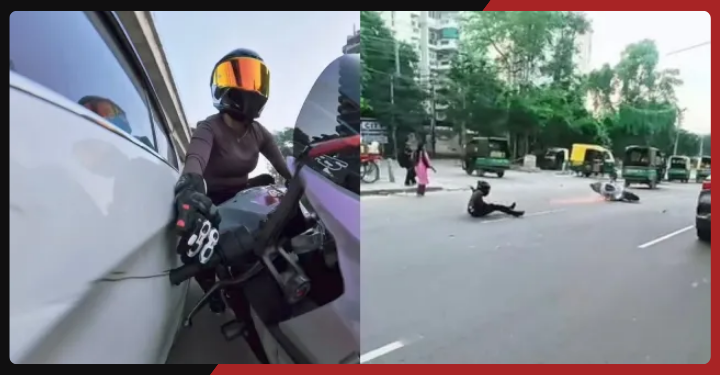

A reported road-rage incident involving a woman sports-bike rider and a car has raised alarm among motorists and bikers in Gurugram. The incident took place on Golf Course Road and was reportedly recorded on camera.
The biker, identified as Sia, was travelling with a group of riders when a car allegedly began following them. According to reports, the vehicle stayed close to the group for some time.
Sia reportedly asked the occupants to maintain a safe distance. Rather than ending the interaction, the car allegedly continued following the bikers.
The situation became increasingly concerning as the group continued along the road. Sia reportedly chose not to stop because she did not want to engage in a confrontation with the people inside the car.
Another biker riding behind her reportedly tried to provide protection by positioning himself between Sia and the vehicle. Despite this, the car allegedly moved toward Sia’s lane and collided with her motorcycle.
The impact reportedly threw her from the bike. The sports motorcycle was dragged along the road before coming to a stop. Footage of the incident has since circulated online and become the centre of public discussion.
According to reports, the car did not stop after the collision. Instead, it allegedly fled the location. This has intensified criticism and prompted calls for the driver to be identified.
The incident illustrates the serious consequences of aggressive driving. A motorist following a motorcycle too closely leaves the rider with less room to react to unexpected situations. If the driver is also attempting to intimidate or force the rider to stop, the risk becomes even greater.
For bikers, the danger is particularly severe. A motorcycle provides no protective cabin, airbags or seatbelt. A rider struck by a car can easily be thrown onto the road, where they may suffer injuries from the initial impact or from contact with other vehicles.
The incident has therefore renewed calls for greater awareness among motorists. Drivers are being urged to treat motorcycles as legitimate road users and give them sufficient space.
It has also raised questions about how road-rage incidents should be handled. Experts generally advise road users to avoid confrontation and move toward a safe location if they feel threatened. Recording the incident, when it can be done safely, may also provide evidence for authorities.
In Sia’s case, the availability of video footage could assist the investigation. Investigators can examine the footage to understand whether the collision was accidental or deliberate and determine the sequence of events leading to the crash.
Social media has played a significant role in bringing attention to the case. After Sia shared her account, other users and members of the biking community began discussing the incident and tagging authorities.
However, online outrage cannot replace a formal investigation. The facts surrounding the collision need to be established through evidence, witness statements and official inquiry.
The incident is ultimately about more than one biker and one car. It reflects a wider road-safety problem in urban India, where congestion, impatience and aggressive driving can combine to create dangerous situations.
Every road user has a responsibility to reduce risk. Maintaining distance, using indicators, respecting lanes and avoiding confrontation can prevent many incidents.
The Gurugram case now serves as a stark reminder of what can happen when road etiquette breaks down. The focus remains on identifying the vehicle, establishing responsibility and ensuring that such incidents do not become normalised on busy city roads.