
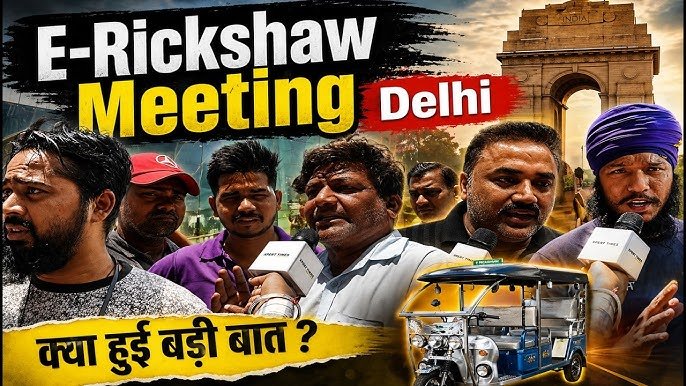

New Delhi: In a long-awaited move, the Delhi government has announced that registrations for new e-rickshaws will resume from May 15, 2026, ending a freeze that had been in place since December last year. The decision, revealed during a high-attendance gathering at Talkatora Stadium, comes as a relief to thousands of drivers and small-scale dealers who have faced months of financial uncertainty.
The event saw a large turnout of e-rickshaw drivers, vehicle dealers, and industry stakeholders. While the announcement brought a sense of optimism, it also opened the floor to longstanding grievances that continue to trouble the sector.
E-rickshaw drivers, who form the backbone of last-mile connectivity in Delhi, expressed concerns about the unpredictability of their daily work lives. Many described facing frequent confrontations on the road, often being blamed for accidents regardless of fault. Several drivers also alleged that they are subjected to harassment during routine checks, despite possessing valid documentation.
“There is no consistency in how rules are applied,” said one driver. “Some vehicles without proper authorization run freely, while others who follow the law are penalized.”
Another major talking point was the announcement of a minimum fare hike. Starting May 1, 2026, the base fare for e-rickshaw rides will increase to ₹20, according to industry representatives. While some drivers welcomed the revision as necessary to offset rising costs, others feared it could reduce passenger demand, especially among low-income commuters.
Small dealers also shared their struggles, noting that the registration halt had severely impacted their business operations. Many reported losses and an inability to sustain their workforce due to the prolonged uncertainty.
The Delhi Transport Minister, addressing the gathering, acknowledged the sector’s challenges and emphasized the importance of e-rickshaws in the city’s transport network. He assured attendees that the government is working toward a more transparent and streamlined regulatory framework.
Despite the positive announcements, skepticism remains. Drivers highlighted the need for better enforcement of policies and protection from arbitrary penalties. Many also called for a grievance redressal mechanism to address their concerns in a structured manner.
E-rickshaws play a critical role in bridging the last-mile connectivity gap in Delhi, particularly in areas where larger public transport systems do not reach. They are also a key component of the city’s push toward sustainable and eco-friendly mobility.
However, stakeholders warn that without consistent policy implementation and fair treatment, the sector could face long-term instability. This would not only affect livelihoods but also disrupt daily commuting for millions.
As the registration process is set to reopen, there is cautious optimism among drivers and dealers. While the announcements mark a step forward, the real test lies in execution.
For now, Delhi’s e-rickshaw community watches closely, hoping that this phase brings not just policy changes, but meaningful improvements on the ground.
