
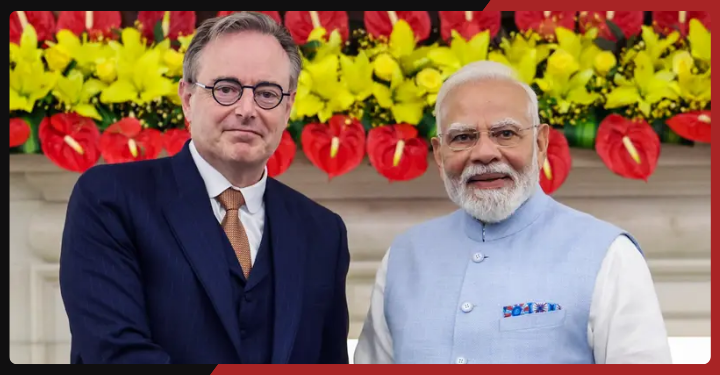

A warning that Europe once failed to take seriously is now helping shape a new strategic conversation between India and European nations.
Belgian Prime Minister Bart De Wever has publicly acknowledged that India warned Europe about the risks of excessive economic dependence long before European governments fully recognised the danger.
According to De Wever, Prime Minister Narendra Modi’s warning was ignored.
But Europe is listening now.
The statement comes during a period of dramatic global change.
The international economy is no longer defined only by traditional ideas of free trade and globalisation. Political tensions, trade disputes and technological competition have transformed economic relationships into matters of strategic importance.
Countries are increasingly concerned about where they obtain essential goods.
They are asking who controls important technologies.
They are reconsidering their dependence on foreign supply chains.
And they are searching for reliable partners.
India has become increasingly important in this environment.
The country is one of the world’s largest economies and is continuing to expand its role in manufacturing, technology and global trade. At the same time, India has maintained a strong focus on strategic independence.
For European countries, this makes India an increasingly attractive partner.
Belgium’s Prime Minister made clear that the relationship should go beyond ordinary commercial exchanges.
India and Europe can build partnerships based on trust.
The India-Belgium relationship is already moving in that direction.
Both countries have agreed to strengthen cooperation across several strategic sectors. Defence cooperation is expanding, while clean energy, critical minerals, technology and investment are also receiving greater attention.
The broader India-Europe relationship is also gaining momentum.
A stronger partnership could help both sides address some of the biggest challenges facing the global economy.
Europe wants more diversified supply chains.
India wants greater investment and technology cooperation.
Europe needs reliable partners.
India wants stronger access to international markets.
These interests are increasingly compatible.
The importance of this relationship is particularly clear in sectors such as semiconductors and critical minerals.
Modern economies depend on these industries. Without advanced chips, technology companies and manufacturing industries face serious problems. Without access to critical minerals, the transition towards clean energy becomes difficult.
No country wants to become excessively dependent in such strategic areas.
That is why partnerships are becoming increasingly important.
De Wever’s comments about India’s earlier warnings therefore have practical significance.
Europe’s changing approach could result in greater investment in India.
European companies may increasingly consider India as a location for manufacturing and supply-chain diversification.
Technology partnerships could grow.
Defence cooperation could become deeper.
And political dialogue between India and Europe could become more strategic.
The world is entering an era where economic relationships cannot be separated completely from geopolitical realities.
Trust matters.
Reliability matters.
Resilience matters.
Belgium’s Prime Minister has acknowledged that Europe took time to understand this.
India, according to him, understood it earlier.
Now, the focus is shifting from recognising the problem to building solutions.
And one of those solutions could be a much stronger India-Europe partnership.
The warning may have been ignored in the past.
But the partnership it has helped inspire could become one of the defining relationships of the future.