
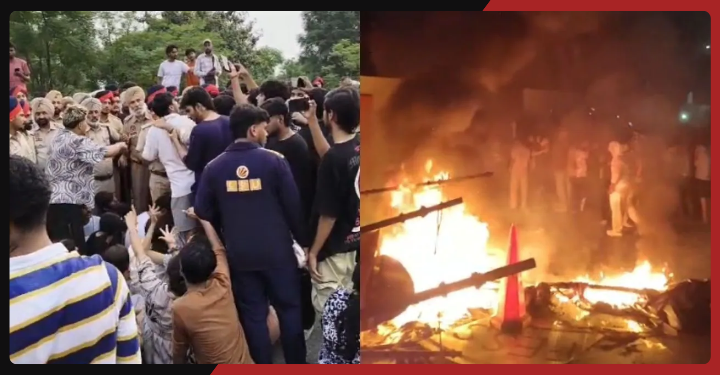

Tension gripped Lovely Professional University in Punjab’s Phagwara after a viral social-media claim alleged that a female student had been raped on campus. The claim prompted an overnight student protest that later escalated into vandalism and a highway blockade, forcing police to intervene.
The allegation emerged through social-media messages circulated among students. The messages reportedly contained multiple claims about what had happened to the student. Some versions referred to an alleged assault by an outsider or construction worker, while other versions included claims that the student had died by suicide.
Authorities did not initially verify those details.
Despite the lack of confirmation, students gathered in large numbers during the night. Reports said the protest began around 2 a.m. near the girls’ hostel.
The emotional nature of the allegation contributed to a rapid escalation. Students reportedly expressed anger over concerns about campus safety and the university’s handling of the situation. Soon, university property began to be damaged.
Window panes were smashed, flower pots were thrown and other objects were damaged. Videos shared online showed disorder across parts of the campus. There were also reports of fire involving objects or portions of buildings.
The university’s security personnel faced difficulty controlling the gathering as the crowd grew. The protest eventually reached the main entrance.
Students then moved onto the nearby highway, blocking traffic. The road disruption affected routes connecting Phagwara and Jalandhar and created congestion.
Police officers, including Kapurthala SSP Gaurav Toora, arrived at the scene. The police official said the gathering had been triggered by rumours circulating online. Officers spoke with students and attempted to address their concerns.
The university administration separately asked students to avoid participating in unrest. It said the messages circulating online were false and misleading and encouraged students to remain inside their accommodation.
However, later developments showed that the police investigation continued beyond simply assessing the rumour. Reports said police received a statement from a student and registered a case concerning the alleged incident. Investigators said they would examine forensic material, CCTV footage and phone records.
This development underscores the importance of separating three different elements of the story: the original social-media claim, the allegation being investigated by police and the acts of vandalism and road obstruction committed during the protest.
The existence of a police investigation does not automatically establish that an allegation is true. Similarly, the fact that some claims circulating online were unverified does not by itself resolve whether an underlying incident occurred.
The police investigation will therefore be central to establishing the facts.
Students have also reportedly raised concerns about hostel management and safety arrangements. According to later reporting, demands included changes to women’s hostel management and greater attention to security measures.
University authorities now face pressure to provide students with credible information and demonstrate that safety complaints can be reported and addressed effectively.
Communication is particularly important during emergencies. When official information is delayed, social-media messages can quickly become the primary source of information for students. Those messages may contain accurate information, partial information or entirely unverified claims.
The LPU episode illustrates how rapidly such information can translate into real-world action. Within hours, a digital claim had contributed to a large physical gathering, damage to university property and disruption of a major highway.
For law-enforcement authorities, the immediate priority was restoring public order. The next stage is determining responsibility for the property damage and establishing the facts surrounding the alleged assault.
Police are also expected to examine digital evidence that may help identify how the original information spread. Investigators may assess phone records, CCTV footage and other available material as part of the inquiry.
For students and families, the central concern is likely to remain safety. University campuses are expected to provide secure residential and academic environments, and allegations of serious crimes naturally create anxiety.
The administration’s response will therefore be judged by how it handles both the immediate investigation and longer-term safety concerns. Transparent communication can help prevent further rumours while allowing investigators to work without interference.
The highway blockade also demonstrated how campus disputes can quickly become wider public-order issues. Once students moved onto a major road, the consequences extended beyond the university community to commuters and other road users.
Authorities have indicated that the situation was brought under control after police deployment and discussions with students.
The case remains developing. The alleged assault should not be presented as an established fact until investigators determine what happened. At the same time, the protest, vandalism and road disruption are documented elements of the incident.
The coming investigation and discussions between university officials and students will determine how the controversy develops and whether changes are made to campus safety arrangements.
