
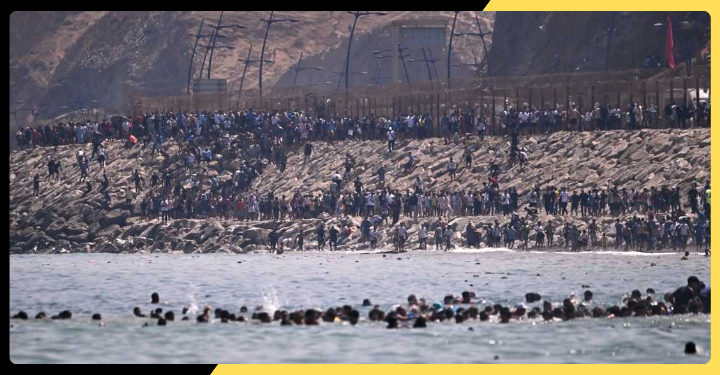

The migrant crisis at the Morocco–Spain border has placed enormous pressure on Spanish authorities, forcing the government to balance two competing priorities: protecting the country’s borders while responding to humanitarian concerns. Following deadly incidents involving attempts to cross into Ceuta, Spain increased security measures, strengthened cooperation with Morocco, and faced intense political debate over how migration should be managed.
One of the most visible responses has been the deployment of additional security forces. Spanish authorities have sent military personnel and extra police support to Ceuta during periods of heightened migration pressure. The presence of the army is intended to assist border operations, support local authorities, and maintain order during large-scale attempts to enter the territory.
However, the use of military forces at a migration border has been controversial. Supporters argue that Ceuta represents an external border of the European Union and that Spain has a responsibility to protect its territory. They say additional resources are necessary when thousands of people attempt to cross a border at the same time, creating risks for both migrants and security personnel.
Critics argue that migration is primarily a humanitarian issue rather than a military one. Human rights organizations have warned that increasing security measures without addressing the reasons people migrate may push migrants toward even more dangerous routes. They have called for policies that combine border management with stronger asylum systems, legal migration opportunities, and humanitarian assistance.
Spain has also worked closely with Morocco to prevent irregular crossings. The two countries share intelligence, coordinate security operations, and monitor migration routes. Spanish officials have repeatedly emphasized that cooperation with Morocco is essential because many migrants reach the Moroccan coast before attempting to enter Ceuta or Melilla.
The Spanish government has also invested in border technology and infrastructure. Security fences around Ceuta and Melilla have been reinforced with surveillance equipment, cameras, and monitoring systems. These measures are designed to detect large groups approaching the border and allow authorities to respond quickly.
Despite these efforts, migration remains difficult to control. Migrants and smuggling networks frequently adapt to new security measures by changing routes or developing new methods of crossing borders. When fences become more difficult to climb, some migrants attempt sea crossings or look for other entry points. This has created a continuous challenge for Spanish authorities.
The political debate inside Spain has been intense. Different political parties have offered competing views on how the country should respond. Some groups have called for stronger border controls, arguing that Spain must prevent illegal entry and protect national security. Others have emphasized the need for greater humanitarian protection and criticized policies they believe place too much focus on deterrence.
Local communities in Ceuta have also experienced the impact of migration pressures. The city has limited space and resources compared with mainland Spain, meaning sudden increases in arrivals can place pressure on housing, social services, and local administration. Residents and officials have called for greater support from the national government and European Union.
Spain has repeatedly asked the European Union to play a larger role in managing migration. Since Ceuta and Melilla are EU borders, Spanish leaders argue that migration challenges affecting these territories should not be treated as Spain’s responsibility alone. They have called for stronger European cooperation, financial assistance, and shared responsibility among member states.
The European Union has also focused on cooperation with countries of origin and transit, including Morocco. The goal is to reduce irregular migration while improving legal pathways for people who qualify to move to Europe. However, disagreements remain among European countries about how responsibility for migrants should be shared.
Another important part of Spain’s response has been efforts to combat human trafficking and migrant smuggling. Authorities have targeted criminal networks that organize dangerous journeys and exploit vulnerable people. Spanish officials argue that smugglers often encourage migrants to take extreme risks by promising successful entry into Europe.
At the same time, experts say security measures alone cannot end migration pressures. Many people attempting to reach Spain are motivated by deep economic, political, and social problems in their home countries. Without addressing these underlying issues, border attempts are likely to continue.
The deployment of the army to Ceuta became a symbol of Spain’s struggle to manage a complex crisis. It highlighted the challenges faced by governments around the world: how to maintain secure borders while protecting human dignity. Spain’s experience shows that migration is not simply a security issue but a global challenge requiring cooperation, compassion, and long-term planning.