
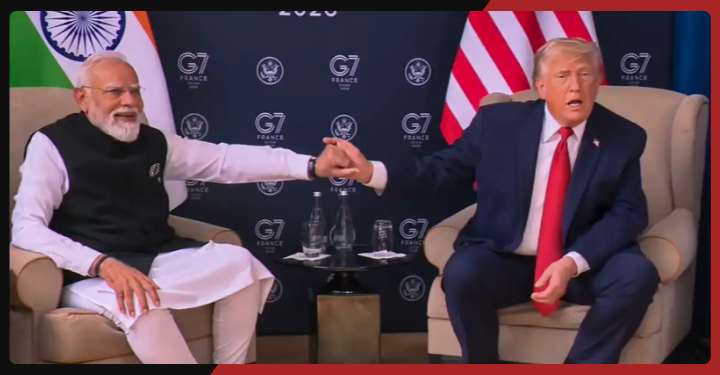

With the United States heading toward the 2026 midterm elections, President Donald Trump is intensifying his campaign for stricter voting regulations—and India’s electoral system has emerged as an important reference point in his argument.
Trump recently praised India’s approach to voter identification and argued that American elections should adopt stronger requirements for proving identity and citizenship.
In a Truth Social post, Trump recalled remarks attributed to India’s Chief Election Commissioner Gyanesh Kumar about the absence of mandatory photo identification in American elections. Trump said India’s most recent election involved approximately 646 million voters and emphasised that every voter was required to have valid photo identification.
The president used those figures to renew his demand for the SAVE America Act.
The legislation seeks to strengthen voter registration requirements by requiring documentary proof of US citizenship. It also forms part of a broader Republican push for stricter voter-identification standards.
The White House says the measure would ensure that only US citizens participate in federal elections. Its official website specifically compares the American system with countries such as India and Brazil, which it says connect voter identification to broader identity databases.
Trump’s focus on India is particularly notable because India administers elections on an extraordinary scale.
The 2024 Lok Sabha election involved hundreds of millions of voters across the country. Voting was conducted in multiple phases, with election officials managing polling stations across cities, villages, mountainous areas and remote regions.
Trump has presented this scale as evidence that strict voter identification does not necessarily prevent mass participation.
But the American debate is complicated by the country’s federal structure.
Unlike India’s centralised election administration, the United States gives states significant control over election procedures. Consequently, voter-identification rules vary from state to state.
Trump wants stronger national standards, particularly for federal elections.
His supporters argue that a uniform system would eliminate inconsistencies and improve confidence in election results. They say voters should be required to prove both who they are and that they are eligible citizens.
Opponents argue that such requirements could place unnecessary burdens on eligible voters. They contend that documentation requirements can create difficulties for people who lack passports, driver’s licences or other acceptable forms of identification.
The dispute is therefore not limited to election security. It also concerns voting access.
The issue has gained urgency because the 2026 midterm elections are approaching. Any changes to federal election requirements could have significant political consequences.
Trump’s administration has already pursued broader changes concerning election procedures and citizenship verification. His voter-ID campaign represents another part of that effort.
Interestingly, Trump’s criticism of mail voting has also featured prominently in the discussion. He cited India’s low level of postal voting as another difference between the two countries.
Trump’s argument has received support from Ambassador Sergio Gor, who publicly endorsed the president’s position and called attention to the scale of India’s election.
However, questions remain about how much of the Indian model can realistically be applied to the United States.
India and America have different constitutional arrangements, voter-registration processes and election-administration structures. Therefore, simply requiring identification would not create identical electoral systems.
Still, Trump’s comparison is politically significant.
India has become a prominent example in the American discussion because of its ability to manage elections involving hundreds of millions of people.
Whether Congress ultimately approves the SAVE America Act will determine how far Trump’s proposal can go. But his latest comments make one thing clear: voter identification will remain a major issue in the American political landscape as the country approaches the midterm elections.
