
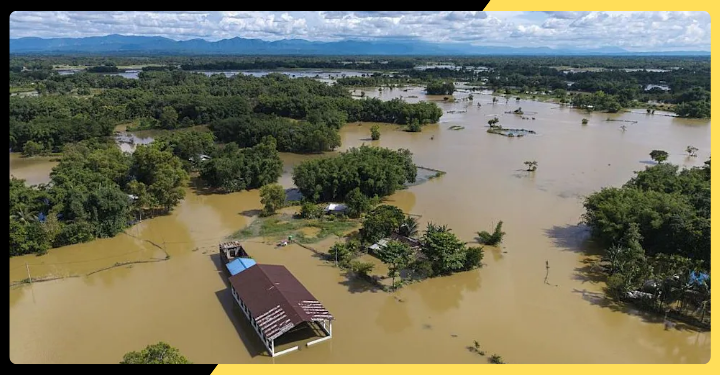

As devastating floods swept across Assam, thousands of families found themselves trapped by rising waters with little time to escape. Entire villages disappeared beneath floodwaters, roads became impassable, and communication networks were disrupted. Faced with one of the state’s most severe flood emergencies in recent years, government agencies, disaster response forces, volunteers, and local communities launched an unprecedented rescue and relief operation to save lives and provide immediate assistance.
The crisis began after days of relentless monsoon rainfall caused the Brahmaputra River and its tributaries to swell beyond danger levels. As embankments gave way, floodwaters spread rapidly across residential areas, agricultural land, and public infrastructure. Thousands of residents were forced to flee their homes, many carrying only a few essential belongings.
The National Disaster Response Force (NDRF), State Disaster Response Force (SDRF), Indian Army, Air Force, Assam Police, Fire and Emergency Services, and local administration coordinated extensive rescue missions across the worst-affected districts. Rescue personnel worked around the clock using inflatable boats, motorboats, helicopters, and specialised rescue equipment to evacuate stranded residents from rooftops, submerged villages, and isolated communities.
Priority was given to children, elderly citizens, pregnant women, and people with disabilities. Medical emergency teams accompanied rescue operations to provide first aid and transport critically ill patients to hospitals. Despite difficult weather conditions and strong water currents, rescue workers continued operations day and night, often risking their own safety to reach remote locations.
Temporary relief camps quickly became the centre of humanitarian assistance. Schools, community halls, colleges, and government buildings were converted into emergency shelters capable of housing thousands of displaced people. Relief camps provided cooked meals, drinking water, blankets, clothing, hygiene kits, baby food, medicines, and temporary accommodation for families who had lost everything.
Healthcare workers established medical camps to monitor public health. Flood disasters often increase the spread of waterborne diseases such as diarrhoea, cholera, dysentery, and hepatitis. Stagnant water also creates breeding grounds for mosquitoes, increasing the risk of malaria and dengue. Doctors, nurses, and health volunteers distributed medicines, conducted health screenings, and promoted safe sanitation practices to prevent disease outbreaks.
Food supply became another major priority. Government agencies, local NGOs, religious organisations, and community volunteers distributed rice, lentils, vegetables, milk, packaged food, and clean drinking water to flood victims. Community kitchens prepared thousands of meals every day for families staying in relief camps.
Livestock rescue teams also played a vital role. Thousands of cattle, goats, poultry, and domestic animals were stranded by floodwaters. Veterinary officers treated injured animals, distributed cattle feed, and vaccinated livestock to prevent disease outbreaks that could further damage rural livelihoods.
Transportation and communication presented enormous challenges throughout the emergency. Damaged roads and collapsed bridges made it difficult to deliver relief materials to isolated villages. In several areas, helicopters air-dropped food packets and essential medicines where boats could not reach.
Financial assistance formed another important component of the government’s response. Compensation programmes were announced for families who lost homes, crops, livestock, or loved ones. Authorities also began assessing damage to schools, hospitals, roads, bridges, irrigation systems, and public buildings to plan long-term reconstruction.
Civil society demonstrated remarkable solidarity during the crisis. Students, youth organisations, local businesses, charitable trusts, and ordinary citizens organised donation drives, collected clothing and food, and volunteered at relief camps. Fishermen used their own boats to rescue stranded neighbours long before official rescue teams arrived.
Technology also played an increasingly important role. Weather forecasting agencies monitored rainfall and river levels continuously, while emergency alerts helped authorities identify high-risk areas and coordinate evacuation efforts more efficiently.
As floodwaters slowly recede, the focus is shifting from emergency response to long-term recovery. Rebuilding homes, restoring roads, reopening schools, repairing hospitals, and reviving agricultural production will require sustained investment and careful planning. Experts argue that reconstruction should focus on climate-resilient infrastructure capable of withstanding future floods.
The Assam flood emergency has demonstrated both the devastating power of nature and the extraordinary resilience of people working together during times of crisis. Rescue teams, volunteers, healthcare workers, and local communities have shown that cooperation can save lives even under the most challenging circumstances. While recovery will take months and perhaps years, the massive humanitarian response has provided hope to thousands of families determined to rebuild their futures.
