
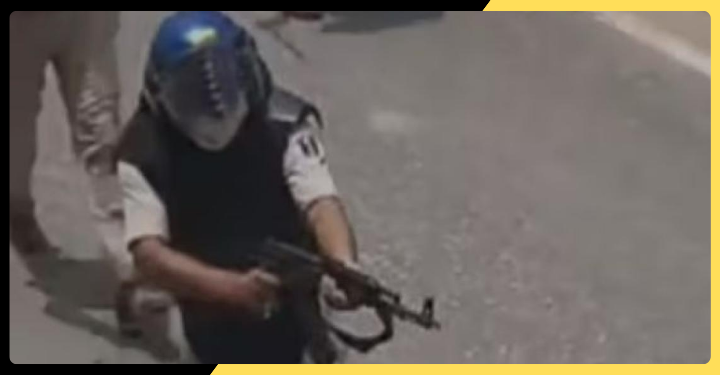

A viral video from Bihar has placed the state’s police force under intense public scrutiny after a constable was allegedly seen using an AK-47 during a student protest in Siwan. The officer has been suspended, but the incident has raised concerns that go far beyond the actions of one policeman. It has triggered a national debate about how authorities respond to student movements and whether the use of force during protests is becoming a political issue.
The incident took place on July 25, during the Bihar Bandh. The shutdown was connected to protests over alleged irregularities related to the NEET-UG examination. Student organisations had been demanding answers and accountability, and demonstrations were reported in different parts of the state. In the middle of this tense environment, footage from Siwan began circulating on social media.
The video appeared to show a police constable in protective equipment carrying an AK-47. The visuals were widely shared and quickly became a subject of public debate. Many social media users questioned whether the use of such a weapon was justified during a protest involving students. Others argued that the complete context of the incident was necessary before drawing conclusions.
Authorities acted after the footage became viral. The constable, posted with the District Intelligence Unit, was suspended with immediate effect. Departmental proceedings were launched, and an inquiry was ordered. Officials have also said that the circumstances surrounding the use of the rifle must be examined. The Siwan SP stated that no one was injured in the firing, although reports about injuries in the wider protest have differed.
The case highlights the growing influence of social media in modern accountability. A single video can now reach millions of people within hours and force authorities to respond quickly. At the same time, short clips can sometimes create incomplete narratives because viewers may not know what happened before or after the recorded moment. This makes official investigation particularly important.
The political response has been swift. Opposition leaders have criticised what they describe as excessive force against students. Rahul Gandhi used the incident to attack the government’s broader approach to student protests, while Tejashwi Yadav questioned the authority behind the deployment of the weapon. The issue has therefore become part of the wider political battle over the NEET controversy and the handling of demonstrations.
The debate has also raised questions about the relationship between police and citizens. Police forces are responsible for maintaining law and order, but they are also expected to protect citizens’ rights. During protests, officers must manage difficult situations where anger, crowds and violence can rapidly escalate. The challenge is to prevent disorder without unnecessarily increasing the risk of serious injury.
The suspension of the constable may be an important first step, but public confidence will depend on what happens next. People will want to know whether the investigation is independent, whether the full video has been examined and whether any other officials will face action if the inquiry identifies wider failures.
For Bihar, the controversy comes at a politically sensitive moment. Student anger over examination issues has already become a major public concern. The AK-47 video has added a new dimension to that anger, making police conduct a central part of the debate.
The incident now stands as a test for the authorities. A transparent investigation could help establish the facts and restore confidence. A vague or incomplete explanation, however, could deepen suspicion and fuel further political confrontation. Until the inquiry reaches a final conclusion, the viral video will remain one of the most powerful symbols of the ongoing debate over student protests, police accountability and the limits of state force in a democracy.
